Showing posts with label Frank Phillip Scrivener. Show all posts

Sunday, February 4, 2024

#52 Ancestors 2024 Week 6 Earning a Living: Frank Scrivener Sr. Moving Away from the Farm

My Scrivener ancestors were farmers in Anne Arundel County MD for almost two hundred years, starting in the early 1700's.  My great-grandfather, Frank Phillip Scrivener Sr., broke that tradition by moving to Baltimore and following a career as an accountant.


Frank was the fifth of the ten children of William Boswell Scrivener and Sally Jane Kent Barber (about whom I have previously written), born at the family farm, Rose Valley, on January 4, 1865. The photo at the left, probably the oldest family photo that I have, shows Frank and his father about 1873.  I'm guessing Frank is about 7 or 8. 

Frank must have been a very bright child because his father decided to send him on for further education after he had completed the local grammar school. As far as I am aware, none of the other children received that benefit. There was no high school in Anne Arundel County at the time, so Frank attended Glenwood Institute in Howard County, near Ellicott City, founded in the 1860's by Lycurgus G. Mathews with the intention of preparing young men for a military academy or Johns Hopkins University.  

Frank's father may have seen an ad like this one that led him to choose Glenwood and pay the handsome sum of $192 a year for his son's education.  Frank graduated in 1881, receiving the gold medal for mathematics that year. 


His talent in math probably helped him land a job as a clerk in Baltimore.  The 1885 city directory shows Frank boarding at 42 W. Mulberry Street. In 1887, he was listed as a bookkeeper, still living on Mulberry Street. The photo at the left shows Frank at about the time he moved to Baltimore, a very handsome man, if I do say so myself. 

In 1895, Frank's father died after a fall from a horse. Frank and his brother Will oversaw the sale of much of their father's land and farm equipment. The Scrivener sons bought the home farm and their mother continued to live there until her death in 1911. The two youngest sons, Jonathan and Kent, joined Frank in Baltimore where they worked as salesmen. Their brothers William and Fred worked the farm back in Anne Arundel County. The sale of the farm in 1936 brought an end to the Scriveners' farming career. 

In the meantime, though, Frank became involved in a little side venture called the West End Theatre and Amusement Company, incorporated in 1894 with the goal of providing high-class entertainment to the citizens of Baltimore, as these articles indicate:

Sadly, the theatre venture was very short-lived.  By 1895, the outfit was bankrupt and had to sell off their property and furnishings.  I don't know how much my great-grandfather was actually involved in the theatre activities.  I suspect he was an investor only and seemed to have misjudged the viability of this venture. Nevertheless, I was totally surprised to discover this hidden aspect of my great-grandfather. 

At some point around this time, Frank met his future wife, Louise Gwynn, the daughter of Captain Andrew Jackson Gwynn and Marie Louise Keene.  Although the family was originally from Maryland, the Gwynns had moved to Spartanburg SC after the Civil War.  But they sent their daughter to Mt. St. Agnes in Baltimore for her education. Perhaps Frank and Louise met at the theatre?  


In any case, however they met, they were married at Louise's sister's home in Upper Marlboro in 1899 with their brother, Rev. Andrew Keene Gwynn, officiating.  Their only child, my grandfather, Frank Philip Scrivener Jr., was born in 1900. That's him on the right with his mother outside their home on Lafayette St. Notice the classic white marble steps. I have written more elsewhere about Baltimore as the Scriveners knew it and their experience with the Great Fire of 1904. 

Having married a devout Catholic, Frank converted from Anglican to Catholic, baptized in 1905 at St. Ann's Church in Baltimore.  

Except for his brief venture into the entertainment business, Frank Scrivener Sr. spent his entire career working as an accountant for the Joseph Gottschalk Company, a well-known importer and distiller of fine liquors, with its own distillery on Saratoga Street, specializing in Maryland rye. Frank worked there until his retirement in 1928. My parents remembered hearing that Grandfather Scrivener had lost money on some of his stocks in the Crash of 1929, and that he invested in a shoe-shine machine that had the unfortunate habit of sometimes catching a person's whole foot in the machine. Perhaps another instance of misjudging his investments? However, he didn't lose everything in the crash as his will still left property and bonds to his wife and son. 

Louise and Frank's son, Frank Jr., attended Baltimore Polytechnic Institute and joined the Navy upon his graduation in 1918.   The photo at the right shows Frank Sr. and Jr. about 1920 with their spiffy Model T. Frank Sr. Later favored Chryslers. Although Frank Sr. did not drive, he was very interested in cars and took care to see that the car was well maintained for his wife’s use.

Frank Jr. married in 1924 and had six children with his wife, Elizabeth Dent. The senior Scriveners moved to Upper Marlboro after Frank's retirement in order to be near Louise's sister, Effie Gwynn Bowie. The six Scrivener grandchildren were frequent visitors to their grandparents, often spending summers in Upper Marlboro and even attending school there. I'm guessing this was probably an attempt to help out with expenses during the Depression.  (Although, according to the family stories, these visits were not always willing ones as their grandmother was quite strict and demanding about their behavior and was not a very good cook!)  

On the other hand, they remembered their Grandfather Scrivener as a kind and gentle man who always had a treat for them--some candy, a nickel, a small toy.  Crippled with arthritis, he apparently spent a great deal of time in his rocker on the front porch. 

As a side note, one of the hidden benefits of these visits was that my Dad met my Mom in Upper Marlboro.  Their families both attended the local Catholic church--St. Mary's--and the Scrivener kids liked to hang out with the Summers kids.  Bonus: Mrs. Summers, my future grandmother, was a great cook, and the Scrivener kids got very good at wangling an invitation to dinner after church. Mom and Dad married at St. Mary's in 1947 as had both of their parents before them. 


Frank Scrivener Sr. died in Upper Marlboro in May 1939 of a heart attack at the age of 74.  In his funeral, held at St. Mary's, Frank was eulogized as "a constant edification to the children of the parish by his reverence when he was in church."  The priest noted that Frank walked very slowly, (He used a cane due to his arthritis.) but always had a cheery word for anyone who spoke to him and was patient and uncomplaining about his suffering. "We will miss his ready smile and twinkling eyes that never lost their brightness." (Great-Grandmother kept detailed notes about the funeral sermon, which I still have.)

He is buried in New Cathedral Cemetery in Baltimore along with his wife Louise Gwynn. 


Of the five sons of William and Sally Scrivener, only Frank had a son himself and kept that Scrivener line from dying out/daughtering out.  Fortunately, there are now dozens of Scrivener grandsons and great-grandsons so the name is safe for the foreseeable future. 


Thursday, January 5, 2023

#52 Ancestors 2023 Week 2 Favorite Photo: The Scrivener Siblings 1935

 The photo below has always been one of my favorites.  It shows my father, Frank Scrivener, with his five siblings. I think it dates from about 1935, when my father would have been ten years old, and was probably taken in Leonardtown, St. Mary's County MD where the family lived in the 1930's. (Their mother, Elizabeth Dent Scrivener, was born and raised in St. Mary's County.)  By 1940, the family was living in Baltimore. 


My dad, Frank Phillip Scrivener III, (1925) is seated at the top left.  Next to him is his brother William Boswell (Chick/Bill) Scrivener (1930).  At the top right is my aunt, the only girl among the sibs, Louise Carmelite (Reds) Scrivener (1926).  You can't see her flaming red hair in this black and white photo. All the boys were blonds or brunettes. 

In the second row is John Marshall Dent (Jack) Scrivener (1928). Next to him is Keene Gwynn Scrivener (1929).  In the front is the baby, Robert Kent (Bob) Scrivener (1933).

In 2023, as I write this, Jack and Bob are still living. 

I have a few other pictures of my dad as a child, but this is the only one with all his siblings. I wonder who was the photographer?  I'm pretty sure the Scriveners couldn't have afforded a camera during the Depression.  So, it must have been a special occasion when someone visited with a camera. 

Anyway, I think this is a delightful picture with its unique expressions of each child. You can tell that this crew must have been a handful for my grandparents to manage. 

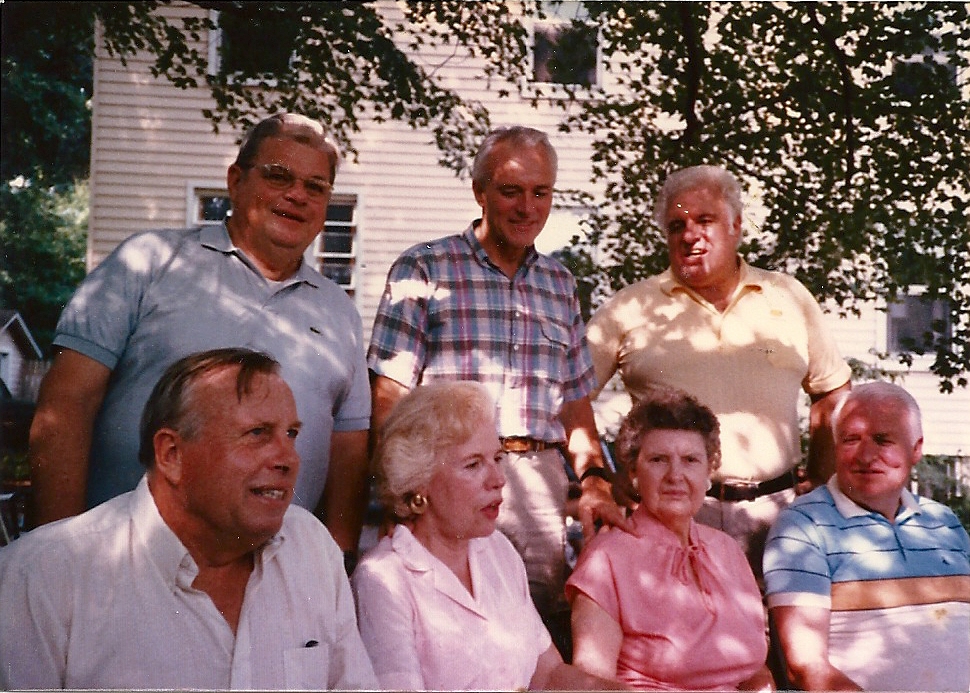
Here is another photo of this group in 1986 with my grandmother Elizabeth Dent Scrivener, as I knew them growing up. 


Keene, Bob, Bill in the back row. Frank, Reds, Lib, and Jack in front. 

I'm glad to have that little glimpse of their childhood from a treasured picture. 


Saturday, December 11, 2021

#52 Ancestors 2021 Week 32 In the City: Scriveners in Baltimore MD


Baltimore, Maryland is my hometown.  I was born there at Mercy Hospital in 1948.  But long before I showed up, many of my Scrivener ancestors had called this city home.  

My 3X great-grandfather, Benjamin Gaither Keene, moved from Dorchester County on the Eastern Shore of Maryland to Baltimore about 1860 and died there in 1865.  He and his wife, Susan Tubman McMullan, were buried in the cathedral cemetery.  Their daughter, Marie Louise Keene, married my 2X great-grandfather, Andrew Jackson Gwynn, in the Baltimore Basilica in 1868.  


Mt. Saint Agnes


Even though the Gwynns spent most of their married life in Spartanburg SC, they sent their daughter, Louise Carmelite Keene Gwynn, back to Baltimore for her education at Mount St. Agnes College, opened by the Sisters of Mercy in 1890 in the Mount Washington area of Baltimore.                                                                                                                                          

My great-grandfather, Frank Phillip Scrivener, was born in Anne Arundel County MD in 1865 and educated at Glenwood Academy in Howard County MD (where he won the gold medal for Mathematics in 1881).  By 1896, he and his two youngest brothers Jonathan and Kent, were living in Baltimore.  Frank was an accountant for the Joseph Gottschalk Company, a well-known importer and distiller of fine liquors with its own distillery at North Saratoga Street, specializing in Maryland Rye. Frank worked for Gottschalk until his retirement in 1928.

 
Gottschalk Distillery


Frank and Louise met in Baltimore, although I do not know the story of their meeting, and married at Louise's sister's home in Upper Marlboro in 1899.  The Scriveners lived in Baltimore until about 1930, raising their only child, Frank Phillip Jr., my grandfather. They moved to Prince George's County MD after Frank Sr.'s retirement. 

I would like to show a little of the Baltimore that Frank and Louise and their son, Frank Jr., would have known during their 30 years in the city.  

After the Civil War, Baltimore industry gathered momentum. The city's connections to the Bay’s fishing industry and the fertile farmland around the Chesapeake Bay helped to concentrate canning factories around the harbor’s edge. In fact, by the 1880s, Baltimore had become the world’s largest oyster supplier and America’s leader in canned fruits and vegetables. In addition, Baltimore was America’s ready-made garment manufacturing center and the world’s largest producer of umbrellas. More than two million immigrants landed first in Fells Point and then in Locust Point, making the City second only to New York as an immigrant port-of-entry. Most new arrivals promptly boarded the B&O Railroad and headed west, but many stayed to create a colorful tapestry of vibrant and diverse neighborhoods. 

City Hall 1873
This growth, however, placed great pressure on Baltimore’s physical infrastructure, and City officials responded. To accommodate this growth, Baltimore expanded its size from ten to thirty square miles in 1888, and still later expanded to 90 square miles.

While horsecars and later trollies expanded Baltimore’s physical reach, steamships and railroads tied Baltimore to the global economy. The B&O Railroad connected Baltimore to the West; the Philadelphia, Wilmington and Baltimore Railroad connected the City to Philadelphia; and the Maryland and Potomac Railroad connected Baltimore to the South.


As of 1893, Baltimore had more millionaire philanthropists than any other city in America; moreover, through the benevolence of four Baltimoreans, modern philanthropy began. 


In 1866 the Peabody Institute opened with a music school, an art gallery, a lyceum, and a library more comprehensive than the Library of Congress. 
Peabody Library

Pratt Library Mulberry St.
Picking up on these themes, Enoch Pratt founded the City’s library system, donating a whopping $1 million gift to Baltimore to launch the nation's first free library system. In 1886, the central branch opened on Mulberry Street, replaced in 1933 by the current building on Cathedral Street.  Given Louise Scrivener's deep interest in American history and family history, and her strong advocacy for various causes, including women's suffrage, I'm quite certain she did research at the Pratt as part of her speech-writing. 


William Walters and his son Henry Walters founded the Walters Art Gallery in their Mt. Vernon home in the late 19th century and about 1905 added an elaborate stone pallazo-style structure in order to allow the public to view their collection.  At his death in 1931, Henry bequeathed the entire collection of more than 22,000 objects plus his home and gallery to the city of Baltimore. 


Wealthy merchant Johns Hopkins envisioned his legacy as a hospital and medical school tied to a university, a radical idea in the late 19th-century that later became the model for virtually all academic medical institutions. At his death in 1873, he left a bequest of $7 million to the university and hospital that would bear his name.  At the time, it was the largest philanthropic bequest in American history. The hospital, completed in 1889, was considered the largest medical facility in the country with 17 buildings, 330 beds, 25 physicians and 200 employees. 


Penn Station 1911
At the dawn of the 20th century, Baltimore’s population reached over half a million. Hundreds of passenger trains were funneled through its five railroad stations; 13 trust companies controlled large areas of Baltimore manufacturing; 21 national banks and 9 local banks controlled Baltimore’s financial interests; 13 steamship companies were engaged in coastal trading; and 6 steamship companies connected Baltimore to foreign ports. Technological progress, economic restructuring, and an increasing population placed great pressure on Baltimore’s urban fabric.

After the Great Fire of 1904, which fortunately for the Scriveners did not reach their part of the city (See The Scriveners and the Great Fire of Baltimore), the downtown smoldered for weeks. The fire consumed 140 acres, destroyed 1,526 buildings, and burned out 2,500 companies. Baltimore quickly began rebuilding, and dozens of buildings were being constructed a year later. Ten years after the fire, Baltimore’s downtown was completely rebuilt. In all, the fire made way for several significant improvements to the downtown: twelve streets were widened, utilities were moved underground, a plaza was established, and wharves were rebuilt and became publicly owned. The fire also led to stricter fire codes for Baltimore and national standardization of fire hydrants and fire-hose connectors. 

The drawing below shows a birds-eye view of the city in 1911 about 7 years after the Great Fire of 1904. This is the Baltimore that the Scriveners would have known, a city of about 500, 000, the sixth largest city in the country. Democrat James H. Preston was mayor from 1911 to 1919. 


Emerson (Bromo-Seltzer) Tower
If you look closely, you can see some landmarks that would have been familiar to the Scriveners, like the 15-story Emerson-Bromo Seltzer clock tower to the left of the harbor. Built in 1911, it was the tallest building in Baltimore at the time.  It was modeled after the Pallazzo Vechio in Florence and built for Captain Isaac Emerson, the inventor of the headache remedy.  The building originally featured a 51-foot revolving replica of the blue Bromo-Seltzer bottle which was illuminated with 596 lights and could be seen 20 miles away. The four-faced tower clock, which displays the letters BROMO SELTZER instead of numbers was designed by Seth Thomas and was the largest 4-dial clock in the world. 


Toward the upper middle of the drawing, you can pick out the famed Washington Monument at Mount Vernon Square, which has graced the Baltimore skyline since 1815, the first monument to honor George Washington.  It was designed by American architect Robert Mills, who later went on to design that other monument in the District of Columbia. 

And if you really squint, you might pick out the Beaux-Art bulk of Penn Station (then known as Union Station) in the far north distance, newly opened in 1911. 

Frank and Louise lived at 105 E. Lafayette Avenue, near Green Mount Cemetery and a few blocks from Penn Station.   I have marked the approximate location on this contemporary map, north of the Bromo Seltzer Tower and the Washington Monument. 


Here is a picture of Louise with her only son, Frank Jr., in front of their house in1901.  Notice the classic white marble steps/stoop typical of Baltimore. Upon their installation in the 1900’s, white marble steps were felt to add an instant element of class and swankiness to otherwise working-class homes. Housewives would scrub the steps every weekend to keep them gleaming.  It's likely that Louise and Frank joined their neighbors in a little stoop-sitting in the humid Baltimore evenings. 

I also have another picture that shows a little of the interior of the Scriveners' home, decorated in a typical Victorian style and crammed with pictures and knick-knacks. That dresser against the wall is still in the family.  

The house at 105 is no longer standing, but here is a contemporary picture of its near neighbors in the 100-block of East Lafayette, so you can get a little feel for the style of the classic Baltimore row house.  This block is a little more upscale that some of the working-class neighborhoods where the houses were just four rooms.  The Scriveners' home was three stories in height and three bays wide. They had a first-floor parlor with a side hall, backed by a dining room, with two bedrooms above. A narrow rear wing provided space for the kitchen on the first floor and more bedrooms on the second and third floors.  Every room had at least one window—except the bathroom, which usually made do with a skylight. In row houses of all sizes, front doors are dauntingly narrow.  An alley usually ran behind the row of houses to provide service access. 


Apart from the monuments and public buildings, Baltimore also provided the amenities of ordinary life for the Scriveners, schools, churches, markets.

Although they may have attended some special services at the Basilica of the Assumption, Baltimore's
Cathedral, the Scriveners' regular parish was St. Ann's on Green Mount Avenue, a few blocks from their home. Frank Scrivener Sr., raised in the Anglican Church, was baptized a Catholic at St. Ann's Church in 1905. Louise Gwynn was a devout Catholic. St. Ann's was established in 1872 by a generous donation from William Kennedy, captain of one of Baltimore's famous Clipper ships.  Caught in a raging storm off Vera Cruz, Kennedy vowed that if his anchor held, he would build a church in thanksgiving.  He made it safely back to Baltimore and kept his vow, naming the church after St. Ann, patron of sailors.  The anchor from his clipper ship still stands next to the cornerstone of the church. 

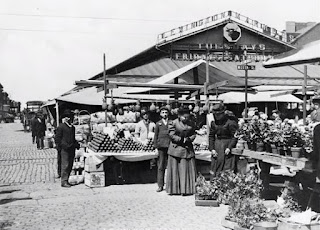
Baltimore's Lexington Market, founded in 1782, is America's oldest market, built on land donated by Revolutionary War General John Eager Howard. By the mid-19th century, it was unquestionably the largest, most famous market on earth. When Ralph Waldo Emerson visited the market, he proclaimed Baltimore "the gastronomic capital of the world."  By 1925, there were over 1000 stalls in 3 block-long sheds. Anything Louise and Frank might have needed in the way of food was available just a few blocks from their home. 

The Baltimore Polytechnic Institute, where my grandfather Frank Scrivener Jr. attended school, was founded in 1883.  By 1913, the school had relocated to a site a few blocks from the Scriveners' home. Poly was considered one of the country's outstanding engineering high schools and Frank went on to a distinguished career as a highway engineer. 
Baltimore Zoo at Druid Hill
The Scriveners lived just a few blocks from Druid Hill Park, one of the first large public parks in America.  Established in 1860, its 745 acres includes the Druid Hill Reservoir and what was then known as the Baltimore Zoo (now the Maryland Zoo).  Established in 1876, the Baltimore Zoo received its early animal collections from prominent Baltimoreans who wanted to enhance the experience of nature in the park. The park is also home to the nation's second oldest Victorian glass conservatory.  The park's winding roadways were a popular place for young drivers to learn their driving skills and it's possible that young Frank Scrivener was among those who practiced in the park and even more likely that he was among the hundreds who flocked there for sledding in the winter. 
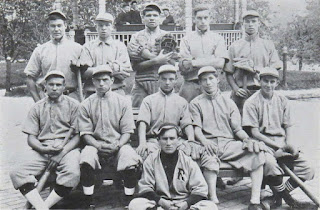

Babe Ruth's team at St. Mary's 1914
Finally, I think it is worth mentioning that George Herman "Babe" Ruth was a contemporary of the Scriveners, living in Baltimore where he was born in 1895.  


At St. Mary's Industrial School, George found his passion for baseball and was offered a contract by the Baltimore Orioles in 1914, at the same time acquiring his nickname, Babe, in reference to his youthful appearance. 

Frank Scrivener Jr. 1908
Babe played only a few months in Baltimore before being traded to the Boston Red Sox.  However, knowing that my grandfather was a very athletic young man and interested in baseball, I feel certain that he saw the Babe in action at old Oriole Park. 

The Baltimore that the Scriveners knew was a thriving, dynamic city that offered its residents a wealth of opportunities and amenities. 


Friday, October 22, 2021

#52 Ancestors 2021 Week 28 Transportation: Five Generations of Road Builders

 My family has roadbuilding in its genes.  For the last five generations, my family has been involved in building and maintaining Maryland's roads.  

Well, technically, it probably goes further back than that.  While much early transportation was done on the waterways, Maryland passed its first public roads law in 1666, ordering county commissioners to make roads passable for foot and horse traffic.  Overseers were appointed in each county and county residents were required to contribute either tobacco or labor toward road maintenance.  I'm sure my ancestors were included in that aspect of road construction.


However, county labor and tax levies were very soon unequal to the demand and road travel, according to contemporary accounts, remained pretty much a harrowing experience throughout the 18th and 19th centuries.  Agitation for better roads came particularly from farmers anxious to get their crops more easily to market and their grain more easily to the mill.  The introduction of the automobile in the early 1900's only increased the demand for better roads.  

Maryland responded in 1898 by asking the State Geologic and Economic Survey to investigate the condition of roads throughout the state and the cost of improving them. In 1908, after seeing the enormous cost of maintaining roads, Maryland established the State Roads Commission to construct, improve and maintain a State system of roads and highways, funded in part by registration fees from those pesky automobiles. 

Maryland Highways ca. 1924


And here is where my family enters the road building picture.  Roads Commission field offices were established in the counties around the state.  My great-grandfather, John Marshall Dent, known as Marshall, (and in the family as Poppa Dent) was hired to help with the investigation of the need for roads and by the 1920's was appointed to run the field office in St. Mary's County.  


Marshall was born in 1873 in Georgia, where his father John Marshall Dent Sr. (known in the family as Big Poppa) had fled to fight for the confederacy during the Civil War.  The family later returned to St. Mary's County and raised ten children there, Marshall being the oldest son.  

Marshall was always a tinkerer and worked as a machinist, ran a lumber mill, and by 1920 was managing a garage. According to my Uncle Jack, Marshall's grandson, Marshall could fix anything and was often consulted by automobile owners about their car troubles. So, he was an excellent choice to work with the State Roads Commission to identify where the county needed new or improved roads. In fact, his work with the State Roads Commission led him to meet his future wife, Mary Turner, as he explored the need for roads in Calvert County.  They married in 1898. 

About 1920, my grandfather, Frank Philip Scrivener Jr., was discharged from the Navy after serving in WWI and was looking for work.  His mother, Louise Gwynn Scrivener, was a noted civic activist who served on numerous government commissions and managed to pull strings with Governor Albert Ritchie to get her son a job with the State Roads Commission.


Young Frank (shown here with his father Frank Sr.) was charged with travelling around the state to visit the various field offices and collect information about where roads needed to be built or enhanced. 

Frank's job had the side benefit of introducing him to Marshall Dent and eventually to Marshall's daughter, Elizabeth, whom Frank married in 1924. (And who would have thought the State Roads Commission could be such a hotbed of romance?) His state job kept him working through the Great Depression and he served the State Roads Commission for 46 years until his retirement in 1968. 


After a series of construction and maintenance posts, in 1931, he was made the maintenance engineer for state roads, and  in 1964 was named Assistant Chief Engineer for Maintenance and Operations.  For more than 30 years, Frank was responsible for the maintenance of Maryland's 4300-mile highway system as well as the equipment necessary to do that maintenance. Among his innovations, he was responsible for the first radio communications system in state roads vehicles and for the development of a prison labor system that kept the roads operating during the labor shortage of WWII.  

A registered professional engineer, Frank earned a national reputation in his field, serving in leadership positions in the Maryland Association of Engineers, the American Association of State Highway Officials and the American Road Builders Association. 


Meanwhile, Frank's oldest son, my father, Frank Philip Scrivener III, born in Baltimore in 1925, also became involved in road-building but from a more hands-on perspective.  After serving in the Army during WWII, and attending Loyola College on the GI Bill, Frank III went to work for E. Stewart Mitchell Asphalt Company in Baltimore.  That's him on the right below with a Mitchell truck.


One of his first jobs was  paving the tarmac and runways for the 3300-acre Friendship Airport outside his home town. (That's a lot of asphalt!) Later, Frank managed to convince the Army that his specialized skills would be more valuable in the US than overseas and he travelled around the country for the government supervising the paving of airport runways as far away as Michigan and South Carolina, a deal worked out to prevent him being recalled to Army service and sent to Korea. 

Friendship Airport 1950

In 1958, Frank had the opportunity to join Tom and Bill Baldwin to form Reliable Asphalt Company in Anne Arundel County MD.  He served as its President until 1978 when Reliable Asphalt became a division of Reliable Contracting. He then served as General Manager of Reliable Contracting until his retirement in 1989.

Dad spent a lot of his time in his green Reliable pick-up truck, travelling around the state to inspect various paving jobs. Driving around was one of his favorite pastimes. As a special treat, or maybe because we were driving Mom crazy and she wanted us out of the house, one or more of us kids would sometimes get to ride with him. I can still remember the pungent smell of fresh asphalt and coming home covered in dust (from the unpaved part of the roads) with asphalt stuck to my shoes (big no-no!) from the newly-paved part of the road.  Dad's favorite jobs were when he got install a tennis court; that was his specialty.  He was a nationally-ranked player and spent almost all his free time with a racquet in his hand. Of course, he built himself a court in our back yard. 

Like his father, Frank was a leader in his field, serving as President of the Maryland Asphalt Association and a board member of the National Asphalt Pavement Association.  


Quite a few of the Scrivener young men got one of their first jobs at Reliable thanks to my Dad.  Even I worked at Reliable in my teens weighing trucks at the asphalt plant and doing office work.  My brother, Robert Keene Scrivener, however, followed more directly in Dad's footsteps and went to work full-time for Reliable after graduating from college. 


Rob has been with Reliable for over 40 years now and serves as Vice President and Chief Operations Officers for the Plants, Paving and Trucking Operations. Like Dad, Rob has served in leadership roles in the Maryland Asphalt Association, the Maryland Transportation Builders and Materials Association and the National Asphalt Pavement Association.  
Rob's sons Bryan and Nathan have continued the road-building tradition for a fifth generation, working at  Reliable as Vice-President of the Southern Division (Charles County) and Director of the Quality Control Lab, respectively. 


Wednesday, March 25, 2020

#52 Ancestors 2020 Week 11 Luck: Frank Scrivener's Lucky Break

My Dad, Frank Phillip Scrivener III, was a member of what is called "the greatest generation." Born in 1925, the oldest son of Frank Scrivener Jr. and Elizabeth Dent, he grew up in Baltimore.  He attended Newman Prep School in New Jersey (thanks to his grandmother) and Calvert Hall in Baltimore.  "Hank," as he was then nicknamed, was a gifted athlete, captaining the tennis team and also playing basketball, as his yearbook noted.  He had plans to enter college.

But, like so many of his peers, his college plans had to be set aside for military service in World War II.  He got in one year at Loyola College in Baltimore before enlisting in July 1943. It was only by a "lucky break" (literally) that he missed fighting in the infamous Battle of the Bulge.

After enlistment, Dad was sent to Ft. Hood TX for basic training and then to Baylor University for advanced training in engineering. He was attached to the 99th Infantry Division, 34th Signal Company.

His division was set to deploy in late 1944, headed for England and later France and Belgium.  The night before shipping out, Frank decided to get in one more round of hoops before leaving.  During the game, he fell and broke his ankle and thus was unable to deploy with the rest of the men.  So, he missed the largest and bloodiest battle of WWII. The 99th Division, outnumbered by the Germans about 5 to 1, lost about 20 percent of its strength there due to death and injury.

Of course, my mother (his girlfriend at the time) did not know that Frank was in a stateside hospital.   He wrote to her, but could not reveal his location, so naturally, she was worried when she saw the news about the devastating battles in Europe.

Eventually, Dad was sent to Europe in February 1945.  He served in Italy as a cryptologic technician, encoding and decoding messages.    (And playing a little tennis in his off hours.)  He was honorably discharged at Ft. Meade MD in March 1946 as a Technician fifth grade.

After leaving the service, Dad married his sweetheart, Anne Summers, and went back to Loyola on the GI Bill graduating in 1949.  In his spare time, he captained the tennis team and showed off his beautiful baby girl--me--to his fellow Greyhounds.  (Back row, 2nd from the right in the picture below.)  So, I guess I would have to say that Dad's lucky break was also mine, because without it, there's a good chance I wouldn't be here.


My mother attributes Dad's lucky break to the St. Christopher medal which he carried with him throughout his war service. Whether it was St. Christopher or some other heavenly guardian, or my mother's prayers, someone was certainly looking out for Dad.