Showing posts with label Sasscer Family. Show all posts

Monday, January 22, 2024

#52 Ancestors 2024 Week 7 Immigration: Part 2 Immigrant Ancestors Maternal Line


In this blog, I am continuing to look at my immigrant ancestors, this time focusing on those from my mother's family. 


1.  Summers

The immigrant ancestor of my Summers family was John Summers, my 7x-great grandfather, who was transported to Maryland from England in 1671.  That probably puts his birth about 1650. By 1672, he was paying ground rent on 120 acres of land called "Pitchcroft" in Calvert County (now Prince George's County), Maryland. A few years later, he married Rebecca (possibly a Dent) and had three children with her: William, John (my 6x-great grandfather), and Sarah. In 1680, John claimed 50 acres of land, having completed his indentured service. John Summers died in Prince George's County MD in November 1705, leaving his estate to his wife, Rebecca and naming his three children in the will. 

2. Gwynn

The immigrant ancestor of this line may have been Hooper Gwynn, my 5x-great grandfather on both my paternal and maternal lines.  He is as far back as I have been able to trace this line.  He was in Prince George's County MD in the 1730's as a School Master and Court Scrivener, indicating that he was an educated man. A man of this name married in Yorkshire, England in 1725.  It's an uncommon name and odds are it is the same person or at least a close relative, but I really can't be sure if the man was born in England (or Wales, since Gwynn is definitely of Welsh origin) or was born in Maryland to immigrant parents.  Hooper Gwinn died in Fairfax County VA about 1759.  He had one son that can be documented: Bennett Gwynn, my 4x-great grandfather on both sides of my family. I have written more about Hooper and the Gwynns here. (With thanks to Effie Gwynn Bowie, Across the Years in Prince George's County.)

3. Hill

The immigrant ancestor of my Hill family was Clement Hill, Jr., my 6x-great grandfather, born 24 February 1670 at Compton Bassett, Wiltshire, England. He came to Maryland in 1693 and stayed with his uncle, Clement Hill Sr., who was a prominent figure in the Province, a member of the Lower House of the Assembly and a member of the Privy Council. In 1696, Clement Hill Jr. married Ann Darnall, the daughter of Col. Henry Darnall. In 1699, he purchased 748 acres of land in Prince George's County MD on the west side of the Patuxent River and built his home there, which he named Compton Bassett, after his home in England. Clement Hill Jr. was the Surveyor General of Maryland. Clement and Ann Hill had five children, including my 5x-great grandfather, Henry Darnall Hill.  Clement Hill died in Prince George's County MD in August 1743. (With thanks to Effie Gwynn Bowie. Across the Years in Prince George's County, Maryland.)

4. Childs

The immigrant ancestor of my Childs line was Henry Childs, my 7x-great grandfather, about whom I have previously written. Henry was born in Amersham, Hertfordshire, England about 1652. He married Ann Ball in 1671 and had ten children with her: Benjamin, Sarah, Mary, Ann, Henry Jr. (my 6x-great grandfather), Ruth, Rachel, Cephas, John, and William.  In 1687, Henry purchased 500 acres of land from William Penn, a fellow Quaker, land which he later gave to his son, Cephas. Henry moved to West River, Anne Arundel County MD where he and his family joined the local Friends Meeting. He died in Anne Arundel County in 1740, leaving his various properties to his children. 

5.  Sasscer

According to family tradition, the Sasscers came from France, but other sources say the Sassers originated in Westphalia/Saxony/Germany and migrated to England after the Norman Conquest in 1066.  The earliest person I have found in my line of Sasscers is Roger John Sarcer/Sasser/Sasscer, my 6x-great grandfather, who may or may not have emigrated from Europe.  A Benjamin Sawcer was found on the Eastern Shore of Maryland in 1671, but I do not know how or if he is connected to Roger.  Roger John Sasser purchased 300 acres of land in Prince George's County MD called "Sarcer's Green" in 1713, so he was probably born in the late 1600's. He later settled near what is now Brandywine, where he purchased additional land. In 1737, Roger deeded "Sasser's Green" to his son John, my 5x-great grandfather. Roger died in Prince George's County MD in 1752.  (With thanks to Lieze Sasscer Moffett, The Sasscer Family of Maryland.)

6.  Gibbons

The earliest Gibbons ancestor I have found is Thomas Gibbons, my 6x-great grandfather.  Thomas, age 14, was in Charles County MD in 1685 when he was presented in court as a servant to William Barton.  So Thomas was born about 1671.  He may have been born in Maryland, or transported to Maryland by William Barton as an indentured servant.  By 1697, Thomas, a planter, was in Prince George's County MD and purchased 100 acres of "Barton's Hope" from William Barton. In 1704, he made further purchases of "Smith's Green" and "Brookefield" in Prince George's County. By that year, Thomas had married Elizabeth (MNU, but possibly Turner). Thomas and Elizabeth had children: George, Turner (my 5x-great grandfather), Christiana (who married my 5x-great grandfather, John Sasscer), and Thomas. Thomas Gibbons died in Prince George's County in 1711, leaving his various properties to his children. 

7. Wallis

The probable immigrant ancestor of my Wallis line is Henry Wallis, my 8X-great grandfather, born about 1650 in England or Scotland. About 1685, Henry petitioned the Lord Proprietor to obtain title to the tract "Boothbies Fortune" in Kent County MD. He probably died in Kent County MD, or he may have gone back to England.  Unfortunately, no other record has been found for Henry.  Henry's son Samuel Wallis, my 7x-great grandfather, was possibly born in England or Scotland and was said to have come to Maryland about 1700 along with William Comegys, another of my 8x-great grandfathers. Samuel married Anne, the widow of William Pearce in 1703/4 in Cecil County MD. He died in Kent County MD about May 1724 and his estate was administered by his wife, Anne. Samuel was an Episcopalian and longtime vestryman of Shrewsbury Parish.  He served in the lower house of the Maryland legislature and owned considerable property on the Eastern Shore, including Boothbies Fortune, presumably inherited from his father, Henry. He bought several properties jointly with William Comegys. Samuel and Anne had seven children, including my 6x-great grandfather, John Wallis. (With Thanks to Guy Wallis, The Wallis Family of Kent County, Maryland.)

8.  Willson

The immigrant ancestor of this Willson family was John Willson, my 7x-great grandfather, born 10 January 1690 in Edinburgh, Scotland. Willson came to Maryland in 1731 and settled on the Wye River at "Greenwood," along with his wife, Elizabeth, and young son Thomas. Willson was a staunch Catholic and engaged in many business dealings with his wealthy Catholic neighbor, Richard Bennett III, who was considered one of the richest men on the continent. Richard Bennett was godfather to Willson's son, Thomas Bennett Willson, and paid for his medical studies in Edinburgh, starting a line of four generations of doctors in the Willson family.  John Willson died in Queen Anne's County MD about 1728. (With thanks to Thomas Joseph Peterson. Catholics in Colonial Delmarva.)

This exercise has reminded me of the relative scarcity of documents for the 17th and early 18th centuries and how fortunate I am that Maryland has a fairly good collection of probate, court and land records from that period.


Wednesday, May 11, 2022

#52 Ancestors 2022 Week 40 Preservation: Restoring John William Sasscer and Julia Gibbons photo

 Among the treasures passed down to me from my grandmother, Evalina Summers, were several very old photographs, printed on glass.  Fortunately, she had identified some of them, including this one of my 2X-great grandparents, John William Sasscer and Julia Gibbons.  Unfortunately, the photo was in very bad shape.


However, I was able to send the photo to a photo restorer who was able to give me a better version so I have at least a hint of what the couple looked like. I suspect that this was a wedding picture taken around the time of their marriage in 1845, when John was 22 years old and Julia 20.


John William Sasscer, born 11 April 1822 in the Peth section of Prince George's County MD, was the only son of Underwood Sasscer and his first wife, Elizabeth Gibbons. He had two sisters, Mary Ellen and Christiana, four half-siblings from his father's second wife, Ann: Philip, Louise, Martha and James, and four more half-siblings from his mother's first marriage to John William Wall: Elizabeth, John, Albert, and Martha Wall. 

Julia Ann Gibbons, born 21 November 1824 in Charles County MD, was the youngest daughter of James Henry Samuel Gibbons and Elizabeth Carrico.  Her six siblings were: Jeremiah, Arthur, Sarah, James, John, Benjamin and George. Her older sister, Sarah Delilah Gibbons also married into the Sasscer family, marrying John William's cousin, Jonathan Throne Sasscer in 1830. 

Betty Marks

Julia married first to Edward Marks in 1841 and had a daughter Elizabeth (Betty) with him.  She married secondly her cousin John William Sasscer 1 April 1845 in Prince George's County MD.

John is enumerated in the 1850 Census of  Prince George's County in the Nottingham District, age 28, carpenter.  His wife Julia, age 27 and his half-sister Louise age 17 are also in the household along with his step-daughter, Betty Marks, age 9, and two sons, William, age 3 and Sebastian, age 0.  Two other sons, both named James, had died in infancy before 1850.  His real estate was valued at $1000. 

In 1851, my great-grandfather, Thomas Reverdy Sasscer, was born and by 1860, John and Julia had five more children: James (1853), Frances (1854), Thaddeus (1856) Julia (1858), and Mary Loretto (1860), all of whom except Loretto (known as Lell), died as children.  The last two children Clarence and Cecilia were born in 1862 and 1863, respectively.  

Julia Gibbons Sasscer died in 1866 and was buried in Old St. Peter's Cemetery in Waldorf MD. Her youngest child, Cecilia, died at the same time and is buried with her mother. 

Shortly after Julia's death, John William Sasscer purchased 150 acres of property in the Keys Quarter area of Prince George's County in 1867 and moved his family into a 1 and a half story house that existed on the property, dating from 1804. 

In 1870, John W. Sasscer, farmer, age 48, is enumerated in the Nottingham district of Prince George's County with children Thomas R. 18, Frances E. 16, Mary L., 9 and Clarence 7. His real estate was valued at $14,000.

John married for the second time to Laura Virginia Cooksey, the widow of Richard Tayman, in Baltimore MD in 1875. John and Laura had no children.

In 1880, John W. Sasscer, farmer, age 58, is enumerated in the Nottingham District of Prince George's County with his wife Laura, age 50 and children John W. 31, Reverdy 30, Mary L. 20, and Clarence 17, as well as his grandson Ambrose, age 3, son of John W. Jr.

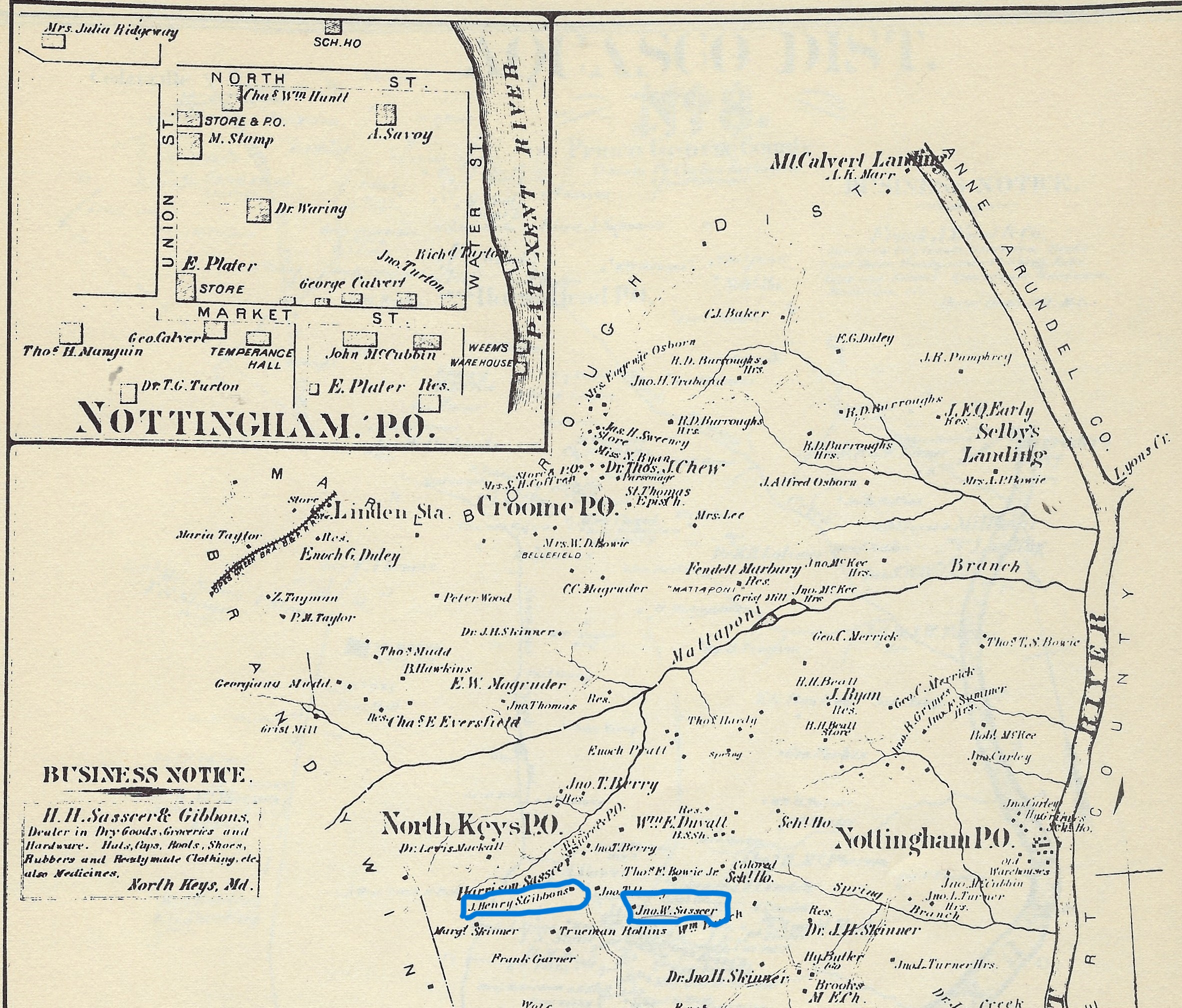
The map below shows the location of John's property in 1878, with the property of his brother-in-law, James Henry Samuel Gibbons, nearby. 


John William Sasscer died in 1882 in Prince George's County MD and was buried in St. Thomas Churchyard in Croom MD. He left his property to his wife Laura and then to his surviving children: Reverdy, Mary Loretto (Lell), and Clarence. 

Clarence DeSales Sasscer married Maria Turner in St. Mary's County MD in 1891 and had three children with her.  He died in a Washington DC Hospital after surgery in 1927.

Thomas Reverdy (Rev) Sasscer (my great-grandfather) married Theresa Evalina (Eva) Wallis in 1894 in Kent County MD. At the time of the marriage, Rev tore down the existing house and built Breezy Hill over the existing basement.  He and Eva raised four children there.  In 1917, Rev bought out his brother Clarence's interest in the property.  Thomas Reverdy Sasscer died in Prince George's County in 1920 at the age of 68. 

Breezy Hill ca. 1930

Loretto (Lell) Sasscer

Loretto Sasscer lived with Reverdy's family at Breezy Hill for many years and never married.  She died at a hospital in Baltimore in 1940 and is buried near her brother Clarence at All Faith Cemetery in St. Mary's County MD. 


Wednesday, February 23, 2022

#52 Ancestors 2022 Week 13 Sisters: Eunice and Evalina Sasscer


 My grandmother Theresa Evalina Sasscer (Summers) and her sister Eunice Loretto Sasscer (Turner) were inseparable.  They were born a year apart in 1898 and 1897 respectively in Prince George's County MD, two of the four children of Thomas Reverdy Sasscer and Theresa Evalina Wallis, along with their brothers Francis Wallis Sasscer and Clarence DeSales Sasscer.  Throughout their lives, they were never far apart. 

I am most fortunate that both my grandmother and my great aunt left wonderful narratives of their growing up on the farm at Breezy Hill, so I would like to share some of that story using their words.  

Eunice and Evalina attended the one-room school across the road from their farm, built on land donated by their father.  The girls were the "janitors," responsible for making the fire every morning and sweeping up the floors.  They used the money they earned for this to pay for music lessons with Mrs. W. Berry Early.  If the weather was especially cold and snowy, their father would go down early and start the old pot belly stove for them. Eunice remembered that they would have geography three days a week and history on the other two days, with English, arithmetic and spelling every day. 

The schoolroom below is not the one they attended, but it gives the idea of what it would have been like. 


During the fall, Evalina said, her brothers would go out early every morning to check the traps for rabbits that might have been caught during the night and all the children would rush to the chestnut trees trying to beat the turkeys at collecting chestnuts that the wind had blown down. 

Evalina described her father as a "kind gentle man who seldom got angry." He worked hard at his farm, but always cleaned up before a meal and put on his black coat before coming to the table. He was strict with the children, especially about their table manners.  "Many was the time," according to Evalina, "that we were sent to the kitchen for giggling at the table."  Rev (as her father was known) made his own cigars from special tobacco leaves that he brought up from the barn and kept in the closet under the staircase. His special love, his daughter said, was his team of spirited horses which he would drive when calling on his friends and to Mass at Marlboro. 

Miss Eunice and Miss Booty

In the mornings, Eunice and Evalina were expected to be at the breakfast table with their chores done: milk, cream, sugar and butter on the table--and no sleeping late.  They also had to make their beds.  One morning, Evalina said, they skipped off to school without doing that chore and their mother sent the cook down to the schoolhouse, where she announced: "Miss Eva (their mother) she say for Miss Eunice and Miss Booty (my grandmother) to come home and make the beds up."  My grandmother said they never tried that trick again. Their mother made all their clothes, and you can see her beautiful work in the photograph above. 

Eunice remembered the pantry at the farm house always had a huge barrel of flour that her father purchased once a year from Baltimore and a keg of sugar.  They raised a lot of corn on the farm which was then ground into corn meal and made into corn bread, which was used to feed the dogs on the farm. (There was no such thing as "dog food."  You had to supply your own.)  She said they always had plenty of milk because they raised cows.  

Evalina
Evalina noted that her Papa had a violin which he played by ear.  Eunice, she said, had inherited that musical talent and would accompany him on the black square piano which her parents had purchased. Eunice and Evalina were each supposed to practice on the piano for an hour after school using a small blue china clock to keep the time. In the winter, the parlor was cold, and they would make a fire to warm the room before practicing.  Evalina said she could remember sitting on her hands to get them warm.  Both the girls loved music; Evalina gravitated more toward the classical, while Eunice tended to play more of the popular music. Eunice remembered that her mother insisted that the girls sit down and play and sing "all the old songs" every Sunday afternoon.  (As a young woman, Evalina worked for the War Department and lived for a time at St. Vincent's orphanage in Washington DC, where Bishop Fulton Sheen was also in residence.  He was her audience in the evenings when she played the piano there.)

For entertainment, Eunice said, there was a lot of visiting among families and friends, driving to each other's houses for skating and sledding parties and attending church suppers.  She also remembered the Tournaments in the summer in various communities where the boys would ride horses with a long spear and use it to capture three balls along the route. Eventually this Jousting became the state sport of Maryland. 

Eunice Sasscer

While their brother Wallis attended Charlotte Hall Military Academy, Eunice and Evalina along with their brother Clarence (as well as my grandfather Paul Summers and you know how that ended up!) attended Baden Agricultural High School, opened in the fall of 1913. They drove a horse and buggy every day to school.  Eunice left Baden after a year and went to Towson Normal School to train as a teacher, taking the train from Brandywine to Baltimore. After graduation, she taught two years in Prince George's County and then in Washington DC for a year before getting married. Evalina finished at Baden in 1916 and then taught for two years before taking a job at the War Department, having decided that teaching was not for her. 

Evalina married her high school classmate Paul Summers in 1924 and lived the rest of her life near Upper Marlboro.  Eunice married Charles Littleton Turner and moved a little further south to Aquasco. 

Sasscer Siblings and their Spouses


As adults, Eunice and Evalina loved to travel everywhere together, especially after Eunice's husband died in 1966 and my grandfather died in 1970. The sisters visited relatives in the States and even travelled to Europe. I never remember attending a family gathering at my grandmother's house where Aunt Eunice was not there. 


Monday, May 4, 2020

#52 Ancestors 2020 Week 23 Wedding: Three Generations of Southern Maryland Weddings

Most of the time, any family historian would count herself lucky to have found a wedding photo of her grandparents.  And I am fortunate to have a charming wedding photo of my maternal grandparents, Paul Francis Summers and Theresa Evalina Sasscer from 1924.  In addition, thanks to my grandmother's tendency to collect clippings, I also have the detailed account of the wedding from the local paper. And further, I also have the photo and newspaper account of the wedding of my great-grandparents, Thomas Reverdy Sasscer and Theresa Evalina Wallis in 1894. (Yes, she was a collector too.)  And, of course, I have the photo and newspaper description of my own parents' wedding in 1947, Frank Philip Scrivener and Anne Theresa Summers.  (At least I know I came by that hoarding gene honestly.)

So, since I have these treasures, I thought it would be interesting to compare the three Southern Maryland weddings and look at how things changed, or didn't over the course of the 50 years that separated these nuptials.

Theresa Evalina Wallis (Eva) was 20 years old when she married Rev Sasscer,  a Prince George's County tobacco farmer who was 23 years her senior. Eva had come to Prince George's County from Kent County on the Eastern Shore to teach in the one-room school house located on the Sasscer property.  She boarded with Mr. Sasscer and his sister and soon the wedding bells were ringing.


The Wallis-Sasscer wedding took place at Sacred Heart Catholic Church in Chestertown, Kent County, the bride's home town on November 14, 1894. The bride wore a handsome gown of "tan henrietta cloth ( a type of fine wool) with gloves and hat to match." She was escorted to the altar by her brother, Francis Wallis, and two other brothers were mentioned as ushers.

The church, according to the newspaper, was beautifully decorated, the altars banked with white and yellow chrysanthemums and the chandeliers festooned with trailing vines.  "Numerous candles shed a mellow light over the scene."

Music for the service included both Mendelsohn's and Lohengrin's Wedding Marches, as well as  Ave Maria, Veni Jesu, and God Be Praised in All His Works, sung in solos and choruses.

After the ceremony, the bridal couple were given a marriage breakfast by Rev. George Ott, the officiating minister.

The bride's parents--Francis Adolphus Wallis and Georgiana Willson--signed the marriage certificate as witnesses.

My grandparents' wedding took place at St. Mary of the Assumption Catholic Church in Upper Marlboro, Prince George's County, on the 26th of April 1924. (As an aside, my paternal grandparents, Frank Scrivener and Elizabeth Dent, were married in the same church just a few weeks later.)  Paul and Evalina had attended school together at Baden Agricultural High School and also attended the same church, St. Mary's. Paul Summers (28) had served in the US Navy during WWI and then returned to the family farm.  Evalina (25) had worked for the War Department in Washington DC and then taught school before her marriage.

The bridge wore a gown of ivory Canton crepe draped with Venetian lace and a tulle veil held in place by a bandeau of orange blossoms. Her sister, Eunice Sasscer Turner, was her matron of honor, wearing pale blue satin duchesse with a white picture hat.  The flower girl was Paul's niece, Dorothy Perrie in a shell pink frock. Since her father had died several years earlier, Evalina was escorted to the altar by her brother, Francis Wallis Sasscer. The groom's best man was his brother Joseph M. Summers.

Jerome Summers (Paul's brother), Clarence Sasscer (Evalina's brother), Charles Turner (Evalina's brother-in-law), and Francis Summers (cousin) were the ushers.

There was music, of course, but the specific musical selections were not named in the account.  The paper did identify the organist, Georgia Wilson, a cousin of the bride and two soloists, Josephine O'Connor and Nellie Ronan.

A wedding breakfast at the home of the bride followed the ceremony.  The paper includes a long list of the guests, a virtual catalog of the siblings and cousins of the bridal couple. The paper noted in particular "the presence of a charming group of children who were nieces and nephews, added another attractive feature to the interesting wedding."

The couple took a "northern trip" (Baltimore, perhaps?) before returning home to settle in at the home of Evalina's mother, Eva Sasscer.

My parents, Frank Scrivener and Anne Summers, were married at the same church, St. Mary's in Upper Marlboro on August 2, 1947.  Frank, 22, had just returned from service in Europe during WWII and was a student at Loyola College in Baltimore.  Anne, also 22, had graduated from George Washington University and was working for the federal government in Washington DC. They had met as youngsters when Frank came down to Upper Marlboro to stay with his Scrivener grandparents.

Their wedding was described by the Marlboro Gazette as "one of the outstanding weddings of Southern Maryland this year."

In addition to the pastor, Fr. McLaughlin, Monsignor Andrew Gwynn of South Carolina, Dad's great-uncle, also officiated at the ceremony.  There were more than 600 guests at the church.

The bride, who was given in marriage by her father, Paul Summers, wore a white gown with a lace bodice and white chiffon skirt with lace panels.  Her fingertip veil was held in place by a lace headdress.  She carried American Beauty Roses.

Wedding music was furnished by Mrs. Roland Ripple, Fred Wyville, Mrs. Arthur Gilman and Olivia Raphel (who was soon to marry Frank's brother Keene).

Evalina Summers was her sister's maid of honor and the other attendants were cousins Brooke Stiefel and Effie Melchior, sister-in-law, Carmelite Scrivener, and friend Jeanne Sauerwein. The attendants wore  frocks in a rainbow of silky faille with matching picture hats. Mary Brooke Kelly was the flower girl and the bride's brother, eight-year old Robert Summers, was the ring-bearer.

Jack Scrivener was his brother's best man, and Paul Summers Jr. (Anne's brother), Jack Fish, Jerry Laroque, and Tom Ostendorf (college buddies and tennis partners of Frank) served as the ushers.


 The reception was held at Maplehurst, the Summers farm, where the large outdoor area could accommodate the hundreds of guests (and the scene of many future weddings, some of which I can remember attending as my mother's younger sisters married.)


The couple left on a "Northern Honeymoon." (As my mother tells this story, Dad planned to take her to a resort where there was a tennis tournament he wanted to play in.  But that is a story for another time.) On returning, they planned to live in Baltimore.

So, here we have three Southern Maryland wedding stories.  All the couples were Catholic and married in a Catholic Church.  The weddings seem to get progressively more elaborate.  Great-grandmother got a nice new dress that she could wear many times after the wedding, while her daughter and granddaughter had specific wedding dresses that probably were not worn again. (Do you notice that none of the wedding articles bother to comment on what the groom was wearing? That didn't change in 50 years.)

On the matter of attendants, all of the wedding parties emphasized family.  Great-grandmother had no female attendants, just ushers, all family members.  Grandmother had a matron of honor and a flower girl as well as ushers, again all family members.  Mother had a full panoply of attendants, male and female including friends as well as family members. 

The celebrations progressed from a simple wedding breakfast at the rectory to a more elaborate breakfast at the bride's home, to a huge celebration with a catered dinner for hundreds of guests.  

What strikes me as the unifying note of all these ceremonies, though, is the degree to which they were family celebrations. The families went all in to start these new couples off in the right spirit.

What do you notice?


Thursday, September 5, 2019

#52 Ancestors 2019 Week 36 School Days: Baden Agricultural High School

Worried that the big cities were stealing away their children, the good citizens of Prince George's County decided to build an agricultural high school designed to "awaken in its pupils a just appreciation for the many advantages of country life."  My maternal grandparents, Paul Francis Summers and Theresa Evalina Sasscer, were among the first students of Baden Agricultural High School.


Baden Agricultural High School, built in 1912 at a cost of $13,000, was the first agricultural high school in Southern Maryland. The Annual Report of the State Board of Education in that year touts the new building as "a fine example of modern school architecture," constructed of "thoroughly waterproofed concrete" with maple floors and woodwork.  The report also noted how "inordinately proud" the local community was that the architect and builder of the school were local men, J. Howe Rawlings and Walter S. Young, respectively. "Who can claim more for one community?" 

As the local newspaper bragged: "The passer-by looks more than once, so attractive in design and esthetics in its harmonious colors is this three-story concrete structure."  The editor went on to rhapsodize the well-equipped laboratory, the domestic science classroom (where samples were dispensed) and the considerable library.  The school even boasted a piano! "Do you wonder at our boastful spirit?"  
 
But more important than the design was the purpose of the school.  According to Principal, W.R.C. Connick:

The establishment of this school is the beginning of a movement by the people of the community to conserve one of their most valuable assets--their boys and girls. The proximity of the large cities of Baltimore and Washington has for years caused such a steady draining away of the young people that it had become imperative that something be done to stop it. Believing that the chief cause of this exodus is the character of the education that is given to their children--fitting them for the city's workshop and the city's office instead of adapting them to the environment of country life--the more progressive spirits of the community asked and received from the General Assembly a bond issue...for the erection of a school, the dominant aim of which would be to awaken in its pupils a just appreciation of the many advantages of country life.

In addition to following the Course of Study adopted by the State Board of Education, Baden Agricultural High School aimed to "equip its boys for the successful solution of the problems of farm life" and to inspire and cultivate in its girls an interest in and love for the highest sphere of women--homemaking."  Baden aspired to be the social and intellectual center of its community, emphasizing the dignity and importance of labor and above all, "to waken an enthusiasm for the glorious privilege of living in God's out of doors."


 This photo is the class of 1916, when both my mother's parents were students there.

My grandfather, Paul Francis Summers is in the back row, fourth from the right next to the girl with the bow. My grandmother, Evalina Sasscer, is seated in the middle row on the left end of the bench in a white blouse with a bow. Grandfather's sister, Ruth Summers, is the girl in the dark dress.

I think my grandparents absorbed the ideals of the school.  Paul Summers went on to found the Marlboro Tobacco Market, a new idea for selling single-leaf tobacco.  He and my grandmother raised nine children on their farm, and if my mother, who cultivated a large garden until she was almost ninety, was any evidence, they all enjoyed the "glorious privilege of living in God's out of doors."


Paul Summers also played on the school's baseball team.  In this photo from 1915, he is in the back row on the far left.

Finally, I found online a wonderful picture of the horse-drawn wagon that served to carry students to Baden Agricultural High School in the early 1900's.  I haven't identified any relatives for sure in this picture, but I think that might be my grandmother seated in the wagon, second from the left.


Here is the graduation program for 1916 that includes both of my grandparents.


Friday, May 31, 2019

#52 Ancestors 2019 Week 22 At the Cemetery: Anne Summers Scrivener, A Life Well-Lived

Since my mother died this week and I have literally been at the cemetery, I will honor her life here.


Anne Summers Scrivener: A Life Well-Lived

Our mother, Anne Theresa Summers, oldest child of Paul Francis Summers and Theresa Evalina Sasscer, (Ma and Pa Summers, to us) was born in Croom, Prince George’s County MD on April 22, 1925. At the time, her parents lived with her maternal grandmother, Theresa Evalina Wallis, widow of  Thomas Reverdy Sasscer.  So Anne spent the first few years of her life at the Sasscer home, Breezy Hill, with her doting grandmother, whom Mom christened "Dama," a name she carried in the family for the rest of her long life. 

A few years later, the family moved to Maplehurst, a tobacco farm just outside Upper Marlboro, where Anne and her eight siblings grew up.  Anne enjoyed the life of a farm girl, feeding chickens, churning butter, and growing prize-winning vegetables. 

Mom attended St. Mary's elementary school and Upper Marlboro High School, where she was a member of the National Honor Society and a champion debater (which no one who knew her later in life could ever doubt).

In addition, her teachers rated her very highly in those intangible traits like initiative and reliability that are so important for success in life. (We have the report card to prove it!)

During her school years, Mom also played the organ for the church when the “real” organist was not available.  As she tells it, she was not really very good at this, but the Sister music teacher pretty much insisted.  She said her trick was that she learned one song very well (“Long Live the Pope!”) and played it slowly for funerals and faster for weddings.


Mom met her future husband, Frank Scrivener III, (son of Frank Scrivener and Elizabeth “Lib” Dent) when he spent his boyhood summers in Upper Marlboro visiting his grandparents, Frank Scrivener Sr. and Louise Gwynn. The Scriveners attended St. Mary’s Church, where the Summers family also attended.  And thus was born an enduring relationship.


Anne attended George Washington University in Washington DC and graduated in 1946, after which she briefly worked for the federal government before her marriage.


Anne and Frank were married at St. Mary’s Church in Upper Marlboro on August 2, 1947, the same church where both Anne's and Frank’s parents were married.

The newlyweds lived in a rented house on Dunkirk Road in Baltimore while Frank attended Loyola College on the GI Bill (and captained the tennis team).   To make a little extra money, they rented their spare bedroom to Loyola basketball players. (Although, as Mom told it, they may not have made much money because those ball players were big eaters!)

In 1956, Anne and Frank and family moved to Millersville in Anne Arundel County, where Frank went to work for Reliable Asphalt and became its president. A few years later, the Scriveners purchased Mapleside Farm with its early-20th-century farmhouse and gorgeous sugar maples lining the driveway.  Mom never forgot her farm-girl roots and was happy to be back in the open country where she could have a garden.  


As a child of the Great Depression, Mom had naturally learned to make do with what she had, a lifelong habit unaffected by any financial security she and her husband eventually achieved. All of her children recall the drawers full of old bread bags, washed and folded tin foil, and stacks of carefully folded A&P bags that filled Mom’s pantry, as well as her habit of cutting the mold off of “perfectly good” cheese, with much eye-rolling by her children. Mom always preserved food, keeping the basement well-stocked with canned peaches, beans, applesauce, jam, and tomatoes.  (The memory of those hot, sticky summer afternoons canning tomatoes is indelibly seared in our brains!) She also made a mean salsa.  By the way, Dave says there are still some 50-year-old jars in the basement, and he is sure they are “perfectly good!”  


Even in her 80’s, many an early morning would find Grandma in the garden in her skirt, blouse and sun hat, attacking those never-ending weeds for an hour or so before daily Mass.


Mom was an accomplished seamstress who made most of her own and her daughters’ clothes, even coats.  A certain red dress with a pinafore was especially memorable and was well-worn by the three girls. (Sorry, brothers, you just didn't look that good in pinafores.) She also made drapes and slipcovers which are still in use at the old family home.


Mom was a devout Catholic, with a special devotion to the Blessed Mother and the rosary.  While some women collect stray cats, Mom couldn’t pass up an orphaned religious statue; no saint was too obscure for her to rescue.  Wondering in Mom’s basement was like being among a veritable communion of wounded saints, waiting for her loving touch. If any of you have been to the old family house, you no doubt recall the life-size, full-color statue that occupies the stairway nook in the front hall. There was a look of pure joy on Mom’s face when she discovered this abandoned Lady in the Annapolis Goodwill Store and took her home to restore her and give her a place of honor at Mapleside.


 On the more-earthly plane, Mom’s house was always full of people.  She loved parties—birthdays, graduations, weddings, wakes, baby showers, family reunions.  She hosted them all.  Family members, classmates, friends, and neighbors could always be sure of a welcome at the Scrivener house.  On numerous occasions, she took in folks who needed a temporary refuge and put them up at her house for weeks or even months at a time.


But the special focus of her affection was her grandchildren and great-grandchildren.  Even after welcoming 70 babies into the family (30 grandchildren and 40 great-grandchildren), she never stopped delighting in each new child.


After 34,366 days on this earth, Mom died May 25, 2019, at home, where she always wanted to be.


Anne Scrivener Agee  Louise Gwynn Scrivener       Maripat Scrivener Rogers

Frank Phillip Scrivener       Robert Keene Scrivener      David Brooke Scrivener

Monday, July 23, 2018

#52 Ancestors Week 8: Heirloom: Grandma Summers' Wine Glasses

#52 Ancestors Week 8: Grandma Summers' Heirloom Wine Glasses

When I got married in 1971, my grandmother, Theresa Evalina Sasscer Summers, gave me some wine glasses which had been handed down in the family for several generations.  It is a gift I still cherish to this day and that I hope one day to pass along to my grandchildren.

The first set of glasses came from the Summers family.

 My grandmother (God bless her sense of family history) also included a note with the wine glasses to tell me where they came from.  


So, I know that these glasses belonged to my great-grandmother Regina Ann Hill, for whom, I am named. (See more about her in my blog from 6 June 2018.)  Perhaps that is why Ma Summers chose to give these glasses to me.  John Kostka Summers and Regina Ann Hill were married in 1878.  If these glasses were a wedding gift, they would be approaching 150 years old.  And they are almost certainly more than 100 years old.

The second set of glasses came from the Sasscer family, my grandmother's parents.


Again, my grandmother thoughtfully provided a note with some history of the glasses.


Dama mentioned in this note was my grandmother's mother, Theresa Evalina Wallis Sasscer. (See more about her in my blog from January 2018.) They were in the Sasscer family sometime before 1894 when Eva married Thomas Reverdy Sasscer.  So, again, they are well over 100 years old.

I enjoy a glass of wine every once in a while using my grandmother's wine glasses.  When I do,  I raise a toast to my grandmothers who cherished these.


Thursday, January 18, 2018

#52Ancestors Week3: Longevity Theresa Evalina Wallis

#52Ancestors

This week's challenge focuses on longevity.  The longest-lived of my direct ancestors was my maternal great-grandmother, Theresa Evalina Wallis Sasscer.   She was born in Kent County MD on 28 December 1874 and died 25 March 1964 in Owings Mills, Baltimore County MD at the age of 90. (I should note, however, that my own mother is still going strong at 93, so I think she will eventually hold the longevity record!)

Eva Wallis was born the same year as poet Robert Frost, industrialist John D. Rockefeller, and magician Harry Houdini.  She grew up in the rural Eastern Shore of Maryland, close to where Harriett Tubman helped the Underground Railroad move slaves to freedom. Ulysses S. Grant was president, following the death of Millard Fillmore.  James Black Groom from Cecil County was the Governor of Maryland. The Wallises came from Quaker roots and were not slave holders.

Eva Wallis was the 8th of the 13 children of Francis Adolphus Wallis and Mary Georgianna Willson. She was a school teacher and met her husband, Thomas Reverdy Sasscer, when she was teaching at a small one-room school in Prince George's County and boarded with Mr. Sasscer, a farmer whose home was across the road from the school.  (Not to worry about any impropriety there because Reverdy's unmarried sister, Mary Loretto Sasscer, was living with her brother as his housekeeper.) Reverdy Sasscer, the son of John William Sasscer and Julia Ann Gibbons of Prince George's County MD,  was some 20 years older than his bride when they married in December 1894 at Sacred Heart Church in Chestertown, Kent County MD.  This picture shows Eva in her wedding outfit. According to the newspaper account of the wedding, it was a gown of tan henrietta cloth with gloves and hat to match.

By the time of her marriage in 1894, Maryland was moving away from its rural roots and becoming more industrialized, although Prince George's County, where Eva raised her family was still mostly farmland, supplying wheat, corn, potatoes, fruits and vegetables for the nation's capital.  Tobacco fields still covered significant areas of the county.

Reverdy and Eva had four children:  Francis Wallis (1895), Eunice Loretto (1897), Theresa Evalina, my grandmother, (1898), and Clarence DeSales (1900).   The Sasscers grew up on a tobacco farm at Breezy Hill and attended the one-room school across the road, where, incidentally, Clarence later met his wife, Madge, who was the teacher there.


Thomas Reverdy Sasscer died in 1920 at the age of 68, so Eva spent the last 44 years of her life as a widow, running the farm with her sons and happily enjoying her brood of 16 grandchildren. It was my mother, Anne, who gave Eva the name by which she was known in the family--Dama--Anne's attempt to say "Grandma."  In her later years, Dama often spent the winters in Florida and my mother, who was her oldest grandchild,  remembers trips to Florida with her grandmother as a teenager.  Dama was very proud of her family heritage and was a member of the DAR and other patriotic societies.  

My memories of my great-grandmother center around the annual family Christmas parties that were always held at Dama's home, Breezy Hill.  It was there that I would see my numerous aunts and uncles, great-aunts and great uncles and dozens of cousins.  I remember her as a very elegant woman. The picture below shows her in 1951 with two of her great-grandchildren at a Christmas party. 


At the time of Eva's death in 1964, J. Millard Tawes, an Eastern Shore native, was governor of Maryland and Lyndon Johnson was initiating the Great Society, amid increasing calls for more minority rights. The Chesapeake Bay Bridge had opened up Eva's native Eastern Shore to greater tourism and Ocean City became a boom town.  The Beatles made their famous appearance on the Ed Sullivan Show and Martin Luther King was awarded the Nobel Peace Prize. 

Both Theresa Evalina Wallis Sasscer and Thomas Reverdy Sasscer are buried in Mt. Carmel Cemetery, Upper Marlboro, Prince George's County MD, along with many of their ancestors and descendants.