Showing posts with label Baden Agricultural High School. Show all posts

Monday, January 16, 2023

#52 Ancestors 2023 Week 4 Education: John Kostka Summers, Supporter of Education in Prince George's County MD


My great-grandfather, John Kostka Summers, was not only an educated man himself (somewhat unusual for his circumstances), but also devoted himself to supporting education for others as a trustee and supervisor of schools in Prince George's County MD, where he lived. 

John Kostka Summers, the oldest of nine children of John Francis Summers and Eliza Gwynn, was born 3 November 1855 at the family home in Westwood, Prince George's County MD. The picture at the left shows him at about age 50. The family has had many discussions about the origin of his middle name, which was certainly not in the family before him.  The Summers were devout Catholics, though, and our speculation was that it was related to the 16th-century Polish saint, Stanislaus Kostka, although we are unclear why this particular saint would have appealed to his parents. Maybe the parish priest gave a particularly rousing sermon on St. Kostka?

In any case, John was followed by 

  • Eugene Summers 1858 (died as an infant)
  • William Aubrey Summers 1859-1928 m. Martha Burch
  • Marie Louise Summers 1861-1953 m. Claude Jarboe
  • Ella Summers 1863-1923 Sr. Mary Rosa of the Holy Cross
  • Edwin Gwynn Summers 1863 (twin)-1922 m. Annie Mace
  • Joseph Alton Summers 1868-1954 m. Mary Rosalie Burch, sister of Martha above
  • Jacobus Sydney Summers 1869-1872 
  • Cora Agnes Summers 1874-1961 m. Frank Thomas Mace, brother of Annie above

Too young to be called up for service in the Civil War, John Kostka was sent to Rock Hill College in Ellicott City MD, a boarding school run by the Christian Brothers, to receive an education. The school advertised a curriculum based on physical education, sciences, and classical studies. The large building shown in the image below was completed in 1865, based on a design by Baltimore architect George A. Frederick, who also designed Baltimore's City Hall.  During the Civil War, which is likely when John Kostka was studying there, the basement of the building was used as a hospital for both Union and Confederate soldiers. As far as I know, John was the only one of the children who went on to further education. Possibly his parents made a special effort for their oldest son. Later census records show that John Kostka completed two years of college.


John Kostka's father, John Francis Summers, died in 1875 at age 51, shortly after the birth of his youngest child.  The house at Westwood had been destroyed in a fire, and Eliza Summers and her children moved in with her elderly in-laws, John Gwynn Summers and Ann Dyer Summers, at the old family home near Baden. This death would certainly have made it very difficult for the family to afford an education for any of the younger children.

In 1878, John Kostka married 20-year-old Mary Regina Ann Hill (for whom I am named), the daughter of Captain Alexander Penn Hill and Mary Elizabeth Childs.  The 1880 Census shows John (a farmer) and Regina living in Nottingham with their infant son, John Lamar Summers. After his marriage, John contracted with the Wyvill brothers to build a new home, which he called Pine Hill, near the site of the burned-out home.  He and Regina raised their family of 15 children there. 

  • John Lamar Summers 1879-drowned 1896, unmarried
  • John Kostka Summers Jr. 1880-1943 m. Benedicta Gannon of New York
  • Emily Louise Summers 1882-1898, unmarried, died in Milwaukee WI of typhoid fever. Likely she was there visiting her maternal aunt, Emily Hill Young. 
  • Alexander Hill Summers 1883-1918, unmarried, died in Spanish Flu epidemic
  • Joseph Mary Summers 1885-1963, unmarried
  • Mary Joseph Summers 1885-1965, twin, Sr. Mary Ange of the Holy Cross, followed her aunt into the order
  • Eliza Mary Summers 1888-1980, married William August Dorr
  • Regina Agnes Summers 1889-1968, married Edwin Payson Springer
  • Gretchen Summers 1891-1953, married Joseph Summerfield Perrie
  • Mildred Elizabeth Summers 1892-1980, married Bernard Aloysius Kummer
  • Dorothy Lucile Summers 1894-1945, married James Heath Dodge
  • Paul Francis Summers (my grandfather) 1895-1970, married Theresa Evalina Sasscer
  • Olin Jerome Summers 1897-1898
  • Emily Ruth Summers 1898-1996, married Charles Henry Adams McPherson
  • Michael Jerome Summers 1902-1967, unmarried (confined to Mt. Hope Retreat/Hospital)
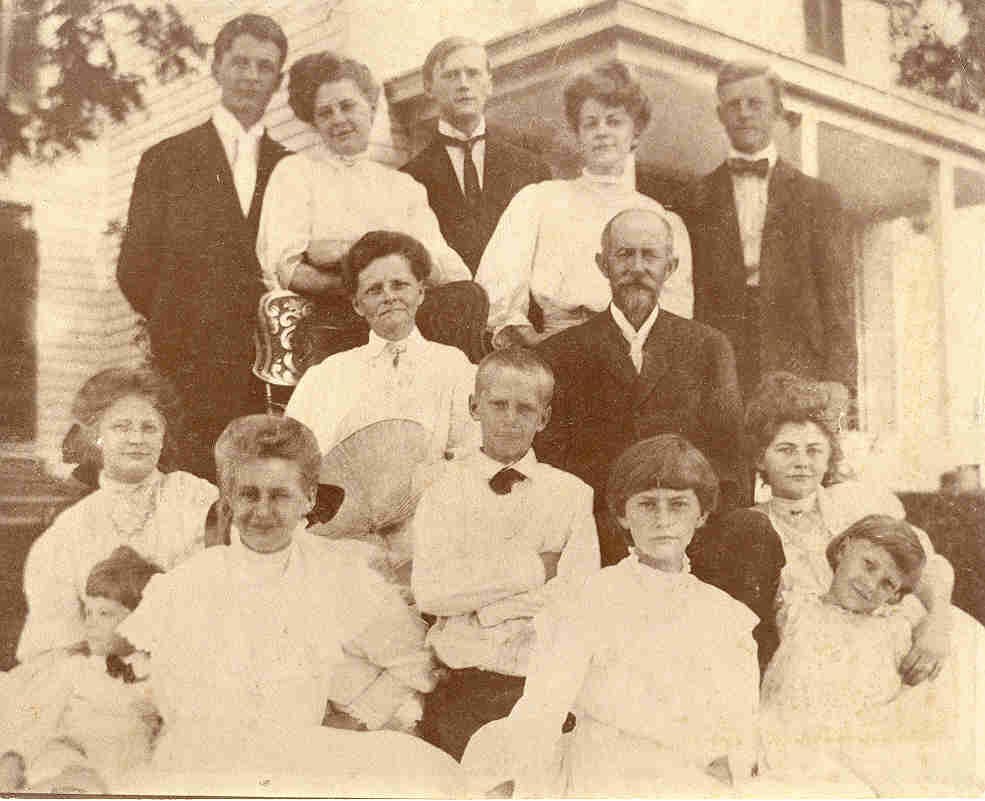
The photograph below shows the family about 1905 at their home in Westwood, Pine Hill. My grandfather, Paul, is in the center between his parents. 


As early as 1897, John Kostka served as a school trustee for the public schools in the Nottingham District of Prince George's County. He was still serving in that role in 1906. In 1914, he was appointed as a trustee for the newly opened Baden Agricultural High School, which my grandfather and his younger sister Ruth attended and where Paul most likely met his future wife who was also a student there. As a trustee of these schools, John Kostka would have help to oversee the finances and policies of the institutions, similar to what a school board would do now.

Census records show that almost all of John's children got a high school education, a tribute to his dedication to the value of learning. I don't have records of where his older children went to school, but it is likely that some of them at least attended the Marlboro Academy, established by the legislature in 1835, the precursor to Marlboro High School. Otherwise, many children at the time attended small, one-room schools that dotted the county. Another of my great-grandmothers, Theresa Evalina Wallis, taught in one of these in Prince George's County, and her daughters attended a one-room school near their home before going on to higher learning institutions. One of her sons attended Charlotte Hall Military Academy.  

In 1910, the Census for the Nottingham District of Prince George's County shows John Summers, farmer, age 54, living with his wife Mary and seven of their unmarried children. In 1920, John is shown with his wife and three sons, along with his 69-year-old widowed brother-in-law, Joseph Benedict Hill.
In the same year, John's mother, Eliza Gwynn Summers was living with her son Edwin at Baden.  She died there in 1914 and is buried beside her husband at Old St. Peter's Cemetery in Waldorf. 

In 1928, John and Regina celebrated their golden wedding anniversary with their family.  I am very fortunate to have a picture from this occasion. 


John Kostka and Regina are seated in the center.  My grandfather Paul is standing just behind Sr. Ange with my uncle Paul Jr. on his shoulder.  My grandmother is standing next to him. But my favorite part of this photo is my mother, three-year-old Anne, in the front row, just to the left of her grandfather, and in front of the young man with the tie, looking thoroughly unhappy to be there. 

By 1930, only their unmarried son Joseph was still living at home with his parents, managing their farm, along with Regina's unmarried brother, Robert E. Lee Hill. 

(An aside, Joseph later went to live with my grandfather, and I can remember meeting Uncle Joe at Pa Summers' home as a young girl. Of the other siblings, Aunt Elizabeth Dorr lived close to my family, and my mother stayed in fairly close contact with her Dorr cousins. Aunt Ruth McPherson was famous in the family for her bread rolls.  My mother kept that recipe in her recipe file, and I can remember sampling them at some family gatherings. There was a very good reason Aunt Ruth was famous for these.)


Mary Regina Ann Hill Summers (who seemed to rotate through those various names at different points in her life) died at Pine Hill 6 June 1932. She is buried at Old St. Peter's Cemetery in Waldorf MD. Although I never met my namesake great-grandmother, I do have an inheritance from her, courtesy of my grandmother.  When I got married, I was gifted a beautiful set of four wineglasses that belonged to Regina. 


In 1940, 84-year-old John Kostka is still living on the Pine Hill farm with his son Joseph and a housekeeper.  Joseph owned the home, valued at $3000. John Kostka died at his home the following year and is buried at Old St. Peter's beside his wife and his parents. 


Obituary: John Kostka Summers

John Kostka Summers, husband of the late Regina Hill Summers, died at his home near Westwood MD on Sunday, March 2, 1941, at the age of 85. Following a short illness, he passed peacefully away during his sleep.

Funeral services were held on Wednesday, March 5 with a Requiem Mass at St. Michael's Church, Baden with Rev. Harrington O'Neil, pastor, officiating and Rev. F.J. Loughran of Upper Marlboro assisting. Interment was in the family lot at St. Peter's, Waldorf. Six grandsons acted as pallbearers and four other grandsons served the Mass, one of whom was Robert Springer, S.J., a student at Woodstock College.

He was born November 3, 1855 at the old homestead near Baden, the son of the late Eliza Gwynn and John Francis Summers and spent his entire life in this community.

He is survived by a large and devoted family: two sisters, Mrs. Claude Jarboe of Washington DC, Mrs. Frank Mace of Baltimore, one brother Mr. Alton Summers of Waldorf MD; the following children: Sister M. Ange of the Order of the Holy Cross in Baltimore; Kostka Summers of New York City; Mrs. E.P. Springer and Mrs. Dorothy Dodge of Washington DC; Mrs. B.A. Kummer of Bristol TN; M. Jerome Summers of Baltimore; Paul Summers of Upper Marlboro; Mrs. Henry McPherson of Aquasco and Mrs. J.S. Perrie and Joseph M. Summers of Westwood and also by forty-one grandchildren and twenty-two great-grandchildren.


Thursday, September 5, 2019

#52 Ancestors 2019 Week 36 School Days: Baden Agricultural High School

Worried that the big cities were stealing away their children, the good citizens of Prince George's County decided to build an agricultural high school designed to "awaken in its pupils a just appreciation for the many advantages of country life."  My maternal grandparents, Paul Francis Summers and Theresa Evalina Sasscer, were among the first students of Baden Agricultural High School.


Baden Agricultural High School, built in 1912 at a cost of $13,000, was the first agricultural high school in Southern Maryland. The Annual Report of the State Board of Education in that year touts the new building as "a fine example of modern school architecture," constructed of "thoroughly waterproofed concrete" with maple floors and woodwork.  The report also noted how "inordinately proud" the local community was that the architect and builder of the school were local men, J. Howe Rawlings and Walter S. Young, respectively. "Who can claim more for one community?" 

As the local newspaper bragged: "The passer-by looks more than once, so attractive in design and esthetics in its harmonious colors is this three-story concrete structure."  The editor went on to rhapsodize the well-equipped laboratory, the domestic science classroom (where samples were dispensed) and the considerable library.  The school even boasted a piano! "Do you wonder at our boastful spirit?"  
 
But more important than the design was the purpose of the school.  According to Principal, W.R.C. Connick:

The establishment of this school is the beginning of a movement by the people of the community to conserve one of their most valuable assets--their boys and girls. The proximity of the large cities of Baltimore and Washington has for years caused such a steady draining away of the young people that it had become imperative that something be done to stop it. Believing that the chief cause of this exodus is the character of the education that is given to their children--fitting them for the city's workshop and the city's office instead of adapting them to the environment of country life--the more progressive spirits of the community asked and received from the General Assembly a bond issue...for the erection of a school, the dominant aim of which would be to awaken in its pupils a just appreciation of the many advantages of country life.

In addition to following the Course of Study adopted by the State Board of Education, Baden Agricultural High School aimed to "equip its boys for the successful solution of the problems of farm life" and to inspire and cultivate in its girls an interest in and love for the highest sphere of women--homemaking."  Baden aspired to be the social and intellectual center of its community, emphasizing the dignity and importance of labor and above all, "to waken an enthusiasm for the glorious privilege of living in God's out of doors."


 This photo is the class of 1916, when both my mother's parents were students there.

My grandfather, Paul Francis Summers is in the back row, fourth from the right next to the girl with the bow. My grandmother, Evalina Sasscer, is seated in the middle row on the left end of the bench in a white blouse with a bow. Grandfather's sister, Ruth Summers, is the girl in the dark dress.

I think my grandparents absorbed the ideals of the school.  Paul Summers went on to found the Marlboro Tobacco Market, a new idea for selling single-leaf tobacco.  He and my grandmother raised nine children on their farm, and if my mother, who cultivated a large garden until she was almost ninety, was any evidence, they all enjoyed the "glorious privilege of living in God's out of doors."


Paul Summers also played on the school's baseball team.  In this photo from 1915, he is in the back row on the far left.

Finally, I found online a wonderful picture of the horse-drawn wagon that served to carry students to Baden Agricultural High School in the early 1900's.  I haven't identified any relatives for sure in this picture, but I think that might be my grandmother seated in the wagon, second from the left.


Here is the graduation program for 1916 that includes both of my grandparents.