Wednesday, June 19, 2019

#52 Ancestors 2019 Week 25 Earliest: Leonard Calvert Maryland's Earliest Settler

Leonard Calvert: Maryland's First Settler

Since this week's theme is earliest, I am writing about my 9X Great-Grandfather, Leonard Calvert, who was among the earliest settlers of Maryland and its first provincial governor.

In 1632, King Charles I of England granted a large tract of land, nearly nine million acres, to George Calvert, Lord Baltimore, (a convert to Catholicism) in gratitude for Calvert's loyal service to the Crown.  Tradition says that Charles himself named the tract "Maryland" (Maria Terra) in honor of his queen, Henrietta Maria. George unfortunately died the same year and the patent to the lands in Maryland passed to his oldest son, Cecil Calvert. As Lord Proprietor of Maryland, Cecil began immediately to plan for the colonization of his American holding.  All those acres would not produce any income unless he could recruit colonists to clear the land and plant tobacco.

So, Lord Baltimore arranged transport for settlers to the New World aboard two ships--the Ark (a 400-ton merchant ship) and the Dove (a smaller pinnacle) supplied with clothing, food and tools to see them through the first year. Although the prospect of a risky 3000-mile voyage to an uncharted wilderness was daunting, Calvert successfully attracted settlers by promising them free land and the rights that land owners enjoyed in England.  A devout Catholic, he also took the unusual step of promising them religious freedom and no public support for any religion, a marked deviation from the religious intolerance of Europe's Roman Catholic countries. (Hence Maryland's nickname: the Free State) Although this experiment in tolerance and separation of Church and state was not entirely successful, it did sow the seeds for later incorporation into the American way of life.

In any case, the Ark and the Dove, with about 140 people on board, left the Isle of Wight on 22
November 1633 and promptly encountered a hurricane.  The Dove was so badly damaged that she had to return to England for repairs, but eventually rejoined the Ark.

Fortunately, the voyagers enjoyed delightful weather for the next three months, and the ships made it comfortably to the West Indies and in due course entered the Chesapeake Bay. After a stop in Virginia to show their charter, they sailed up the Potomac River and landed at St. Clements Island, where they erected a great wooden cross and celebrated Mass on the 25th of March 1634.  The day has been celebrated ever since as Maryland Day.  The settlers negotiated with the local Native American tribe, the Yoacomoco, who agreed to sell a village to the Calverts in exchange for gifts, trading guarantees and protection from their enemies, the Susquehannock and Iroquois tribes.  The Yoacomoco village became the English settlement of St. Mary's City and the first capital of Maryland.  


Cecil Calvert had become bogged down in Royal court politics, because of growing anti-Catholic tensions in England and also because the colony of Virginia was lobbying the king to have the Maryland colonial grant abolished.  Therefore, Cecil had to remain vigilantly involved in court politics in order to protect his charter from anti-Catholic and Virginia colony lobbyists. Thus it fell to Cecil's younger brother, Leonard, to lead the colonists to Maryland and serve as the province's first governor.


Leonard Calvert, named after his paternal grandfather, was born in England in 1606.  The settling of Maryland was not Leonard's first venture at colonization.  In 1625, Leonard had accompanied his father as he had tried to create a colony called Avalon on the island of Newfoundland.  But ultimately, Lord Baltimore declared that a failure due to the extreme cold and attacks by the French and asked the king for a land grant in the warmer climate of Virginia, which, as noted above, he was finally granted in 1632, but did not live to see fulfilled.  Leonard was admitted to Gray's Inn (which meant he could practice law) in 1633, shortly before leaving for Maryland. As Governor, Leonard Calvert was in charge of Maryland's militia, sea forces, court system and finances.  Although the new governor at first attempted to govern in an absolutist way, he was eventually forced to call a colonial assembly, which became the foundation for Maryland's General Assembly and the third legislature to be established in the colonies, after Virginia's House of Burgesses and Massachusetts' General Court.

In 1638, Governor Calvert seized a trading post at Kent Island established by Virginian William Claiborne.  In 1643, he returned to England to discuss policies with his brother Lord Baltimore, leaving the colony in charge of  Giles Brent. He returned in 1644 just in time to face an uprising by William Claiborne and the Protestant colonists against the Catholic Proprietor. The English Civil War reached the shores of the Chesapeake as Captain Richard Ingle attacked and plundered St. Mary's City in an attempt to claim the Maryland colony for England's Parliament. Leonard escaped capture and fled south to Virginia and eventually returned at the head of an armed force and reasserted Lord Baltimore's rule in 1647.

However, Leonard died of disease that same summer.  In his will, he appointed Margaret Brent (future historically famous advocate for women's rights) as his executor and named Thomas Greene as the next Governor of Maryland. 

Leonard Calvert married in England, although the identity of his wife is not known.  Recent evidence has shown that Ann Brent, whom he was thought to have married, was in fact a spinster, but his wife may have been a member of the Brent family.  He did have two children, William, born in 1643, and Ann, born in 1644. The children were apparently raised in England and emigrated to Maryland years later after the death of their father.

Anne Calvert, my 7X Great Grandmother, married first Baker Brooke, who died in Calvert County MD in 1679, leaving his large estates to his wife Anne. Anne married secondly, Henry Brent (possibly a cousin), and thirdly Richard Marsham, a justice of Prince George's County MD. Baker Brooke II, my 6X great-grandfather, married his step-sister, Katherine Marsham.

Leonard Calvert's burial place is not known (although there is an archeological search underway for it.)  However, the state of Maryland did erect a monument to Leonard Calvert in 1890 in Trinity Churchyard in St. Mary's City.


Monday, June 3, 2019

#52 Ancestors 2019 Week 23 Namesake--Henrietta Maria Neale, Grandmother of the Eastern Shore

#52 Ancestors 2019 Week 23 Namesake--Henrietta Maria Neale, Grandmother of the Eastern Shore
Queen Henrietta Maria

Henrietta Maria Neale, the daughter of James Neale and Anna Maria Gill, and my 9X great-grandmother, was herself a namesake to Queen Henrietta Maria, wife of King Charles I.  Henrietta's mother was said to have been a lady-in-waiting to the queen and family tradition says the queen was godmother to her namesake.

Henrietta Maria Neale was born in Spain in 1647, as her father served as the King's representative there.  James and his family later came to Maryland, receiving a land grant for services to the crown.

Henrietta married twice, first to Richard Bennett and second to Philemon Lloyd, and had twelve children with her two husbands.  Her son Richard Bennett III was the wealthiest man in Maryland in the early 1700's and her son Edward Lloyd became acting Governor of Maryland from 1709 to 1713.

But Henrietta's claim to fame was not her sons.  Madam Lloyd, as she was known, was not only the wealthiest woman on the Eastern Shore, but also its social leader and a capable business woman who managed the complex affairs of Wye House. She had wealth, beauty, and power, as well as fierce independence.  She founded such a prolific dynasty of descendants that she has been referred to as the "Grandmother of the Eastern Shore." A daughter named Henrietta Marie shows up at least once, and often more, in every generation.

Henrietta's daughter Susanna Maria Bennett produced two namesake daughters, one with each of her two husbands--Henrietta Maria Darnall (1684, daughter of John Darnall) and Henrietta Maria Lowe (1697, daughter of Col Henry Lowe.)

Henrietta Maria Chew
 Her son Philemon Lloyd named his first daughter Henrietta Maria in 1710.  She went on to marry Samuel Chew and name her first daughter Henrietta Maria Chew in 1728.  When that little girl died a year later, the name was also given to the second daughter in 1730.  Henrietta Maria Chew married Edward Dorsey and named her first daughter Henrietta Maria Dorsey.

Madam Lloyd's son James Lloyd married Ann Grundy and named his first daughter Henrietta Maria Lloyd in 1711. That daughter married Samuel Chamberlaine and named two daughters Henrietta Maria, the second born after the death of the first.
Henrietta Maria Tilghman


Madam Lloyd's daughter Anna Maria married Colonel Richard Tilghman and produced a daughter Henrietta Maria Tilghman 1707.  She married George Robins and had a daughter Henrietta Maria in 1736.
By the time of her death in 1697, just about every important family on the Eastern Shore of Maryland had a connection by marriage to Madam Lloyd and most had a namesake daughter in the house.

Her epitaph is still visible in the Lloyd family graveyard at Wye House:

Henrietta Maria Lloyd
Shee who now takes her rest within this tomb,
Had Rachell's face and Lea's fruitful womb,
Abigail's wisdom, Lydea's faithful heart,
with Martha's care and Mary's better part.
Who died this 21st day of May,
Anno Dom. 1697


Friday, May 31, 2019

#52 Ancestors 2019 Week 22 At the Cemetery: Anne Summers Scrivener, A Life Well-Lived

Since my mother died this week and I have literally been at the cemetery, I will honor her life here.


Anne Summers Scrivener: A Life Well-Lived

Our mother, Anne Theresa Summers, oldest child of Paul Francis Summers and Theresa Evalina Sasscer, (Ma and Pa Summers, to us) was born in Croom, Prince George’s County MD on April 22, 1925. At the time, her parents lived with her maternal grandmother, Theresa Evalina Wallis, widow of  Thomas Reverdy Sasscer.  So Anne spent the first few years of her life at the Sasscer home, Breezy Hill, with her doting grandmother, whom Mom christened "Dama," a name she carried in the family for the rest of her long life. 

A few years later, the family moved to Maplehurst, a tobacco farm just outside Upper Marlboro, where Anne and her eight siblings grew up.  Anne enjoyed the life of a farm girl, feeding chickens, churning butter, and growing prize-winning vegetables. 

Mom attended St. Mary's elementary school and Upper Marlboro High School, where she was a member of the National Honor Society and a champion debater (which no one who knew her later in life could ever doubt).

In addition, her teachers rated her very highly in those intangible traits like initiative and reliability that are so important for success in life. (We have the report card to prove it!)

During her school years, Mom also played the organ for the church when the “real” organist was not available.  As she tells it, she was not really very good at this, but the Sister music teacher pretty much insisted.  She said her trick was that she learned one song very well (“Long Live the Pope!”) and played it slowly for funerals and faster for weddings.


Mom met her future husband, Frank Scrivener III, (son of Frank Scrivener and Elizabeth “Lib” Dent) when he spent his boyhood summers in Upper Marlboro visiting his grandparents, Frank Scrivener Sr. and Louise Gwynn. The Scriveners attended St. Mary’s Church, where the Summers family also attended.  And thus was born an enduring relationship.


Anne attended George Washington University in Washington DC and graduated in 1946, after which she briefly worked for the federal government before her marriage.


Anne and Frank were married at St. Mary’s Church in Upper Marlboro on August 2, 1947, the same church where both Anne's and Frank’s parents were married.

The newlyweds lived in a rented house on Dunkirk Road in Baltimore while Frank attended Loyola College on the GI Bill (and captained the tennis team).   To make a little extra money, they rented their spare bedroom to Loyola basketball players. (Although, as Mom told it, they may not have made much money because those ball players were big eaters!)

In 1956, Anne and Frank and family moved to Millersville in Anne Arundel County, where Frank went to work for Reliable Asphalt and became its president. A few years later, the Scriveners purchased Mapleside Farm with its early-20th-century farmhouse and gorgeous sugar maples lining the driveway.  Mom never forgot her farm-girl roots and was happy to be back in the open country where she could have a garden.  


As a child of the Great Depression, Mom had naturally learned to make do with what she had, a lifelong habit unaffected by any financial security she and her husband eventually achieved. All of her children recall the drawers full of old bread bags, washed and folded tin foil, and stacks of carefully folded A&P bags that filled Mom’s pantry, as well as her habit of cutting the mold off of “perfectly good” cheese, with much eye-rolling by her children. Mom always preserved food, keeping the basement well-stocked with canned peaches, beans, applesauce, jam, and tomatoes.  (The memory of those hot, sticky summer afternoons canning tomatoes is indelibly seared in our brains!) She also made a mean salsa.  By the way, Dave says there are still some 50-year-old jars in the basement, and he is sure they are “perfectly good!”  


Even in her 80’s, many an early morning would find Grandma in the garden in her skirt, blouse and sun hat, attacking those never-ending weeds for an hour or so before daily Mass.


Mom was an accomplished seamstress who made most of her own and her daughters’ clothes, even coats.  A certain red dress with a pinafore was especially memorable and was well-worn by the three girls. (Sorry, brothers, you just didn't look that good in pinafores.) She also made drapes and slipcovers which are still in use at the old family home.


Mom was a devout Catholic, with a special devotion to the Blessed Mother and the rosary.  While some women collect stray cats, Mom couldn’t pass up an orphaned religious statue; no saint was too obscure for her to rescue.  Wondering in Mom’s basement was like being among a veritable communion of wounded saints, waiting for her loving touch. If any of you have been to the old family house, you no doubt recall the life-size, full-color statue that occupies the stairway nook in the front hall. There was a look of pure joy on Mom’s face when she discovered this abandoned Lady in the Annapolis Goodwill Store and took her home to restore her and give her a place of honor at Mapleside.


 On the more-earthly plane, Mom’s house was always full of people.  She loved parties—birthdays, graduations, weddings, wakes, baby showers, family reunions.  She hosted them all.  Family members, classmates, friends, and neighbors could always be sure of a welcome at the Scrivener house.  On numerous occasions, she took in folks who needed a temporary refuge and put them up at her house for weeks or even months at a time.


But the special focus of her affection was her grandchildren and great-grandchildren.  Even after welcoming 70 babies into the family (30 grandchildren and 40 great-grandchildren), she never stopped delighting in each new child.


After 34,366 days on this earth, Mom died May 25, 2019, at home, where she always wanted to be.


Anne Scrivener Agee  Louise Gwynn Scrivener       Maripat Scrivener Rogers

Frank Phillip Scrivener       Robert Keene Scrivener      David Brooke Scrivener

Friday, May 24, 2019

#52 Ancestors 2019 Week 21 In the Military: Lt. Francis Wallis, Quaker Soldier

By the mid-eighteenth-century, there was a large population of the Religious Society of Friends (Quakers) in Maryland and throughout the thirteen colonies.  The American Revolutionary War created considerable problems for the Quakers and their Peace Testimony, which eschewed violence and encouraged diplomacy as the way to deal with conflicts.  Quaker merchants opposed the Stamp Act and the Townshend Acts, but with the Declaration of Independence in 1776, the Friends were forced to deal with a situation that could no longer be resolved without violence.

In October 1773, Philadelphia Yearly Meeting cautioned the Friends to “keep quiet and still both in respect to conversation and conduct on such public occasions.” In January, 1775, the Meeting for Sufferings met long hours, day after day, resolving that Monthly Meetings must discipline Friends who participated in the Continental Association or any other group fostered by the Continental Congress. If members disregarded the admonitions, they were to be disowned. When this was read in Friends meetings across the colonies, the epistle “aroused great displeasure on the part of the friends of freedom and liberty.”(See Journal of the American Revolution.  A Quaker Struggles with the War.) Through disownment, Friends expressed their concern over the reputation of their religion and its testimonies.

Most Friends followed their faith and largely stayed out of the conflict.  Quakers who refused to support the war often suffered for the religious beliefs, being arrested for refusing to pay taxes and answer conscription calls. Some Friends made donations to support the besieged city of Boston and others tended to the wounded on the battlefields.  But according to historians, over 1700 Friends were disciplined or disowned by their meetings for participating in the Revolution in some way.  One of the most famous of these "Fighting Quakers," was Nathanael Greene of Rhode Island, an aide to George Washington and the commander of the southern forces of the Continental Army.

Another of these "Fighting Quakers" was my 5X great-grandfather, Francis Wallis, of Kent County MD.  Francis, the eldest son of John Wallis and Hannah Bodien, was born in Kent County 5 December 1749.  He was raised in the Quaker faith and was a member and elder of the Cecil Meeting of Friends. In 1773, he married Sophia Brooks, the orphaned daughter of Henry Brooks and Sarah Shawn, whom the Cecil meeting had entrusted to the care of Francis's cousin, Samuel Wallis. Francis and Sophia Wallis had two children: John, born in 1775 and Sarah, born in 1778.

Early in 1775, just about the time that his son was born, Francis decided that he needed to join the fight for American independence.  He was commissioned a 2nd Lt. in Captain Nathaniel Comegys 7th Company of the 27 Battalion of the Kent County Militia.  His battalion was part of the Flying Camp and he fought from 1775 to 1778. The Cecil Meeting of Friends disowned him and his wife because of his decision.

Both Francis and Sophia lived to the see the end of the war with the 1783 Treaty of Paris.  Sophia was reconciled with the Friends before her death in 1785,  and Francis married a second time to Elizabeth Smith.  Francis and Elizabeth had a daughter Hannah Bodien Wallis in 1786.

Francis died in Kent County in 1789.  The Quakers forgave him in death and he is buried under the oaks at the Cecil Meeting House in Chestertown.


Sunday, May 19, 2019

#52 Ancestors 2019 Week 20 Nature: Margaret Tilghman Carroll, Gardener Extrordinaire

Margaret Tilghman Carroll, the woman who helped to design George Washington's gardens

Margaret Tilghman, the daughter of Matthew Tilghman and Anne Lloyd, was born in Talbot County MD in 1742.  At the age of 21, Margaret married Charles Carroll the Barrister (a distant cousin of Charles Carroll, the signer of the Declaration of Independence.) She was also the sister-in-law of Tench Tilghman, George Washington's wartime aide.

Margaret and Charles Carroll took up residence at Mount Clare in Baltimore, a Georgian style mansion that Charles began building in 1756 on property inherited from his father.  He named it Mount Clare in honor of his grandmother, Mary Clare Dunn. The house was built with soft pink brick, laid in all-header bond, most of which would have been made on the plantation. A series of grass ramps led from the bowling green down shaded terraces or falls.  A sweeping view spread across the lower fields to the waters of the Patapsco River, about a mile away.

While her husband was busy with affairs of state, serving in the legislature and on the Committee of Correspondence and the Council of Safety, Margaret Carroll, a skilled and avid gardener, delighted in designing the grounds of Mount Clare, which is shown in the background of the picture below. 

Her most famous addition was the orangery, where orange, lemon, and peach trees bloomed.  She also had a "pinery" where she grew pineapples and broccoli. 


Because of her expertise, George Washington consulted with Margaret for advice on what plants to grow at Mount Vernon and how to build and heat a greenhouse.  Mount Vernon's greenhouse (which burned in 1835) resembled the orangery at Mount Clare. Margaret also supplied Washington with saplings from her own greenhouse and advised him on how best  to grow trees. See Mount Vernon gardens on the right.  


Margaret survived her husband by more than 30 years and never remarried.  She devoted herself to remodeling Mount Clare.  She died in 1817 and is buried with her husband at St. Anne's Churchyard in Annapolis MD. 

The Carrolls had no surviving children and by the mid-nineteenth century, industrialization was encroaching on the property.  In 1890, the Carroll heirs sold the house and 20 acres to the city of Baltimore as a public park. In 1903, the Olmstead brothers were hired to make improvements to the park and many of the features they designed are still visible in Carroll Park. 

In 1917, the Colonial Dames assumed custodianship of the house and manage it to the present day as a museum.  In 1970, Mount Clare was designated a National Historic Landmark. The house still contains much of Margaret Tilghman Carroll's furniture and designs. 


See Mount Clare's website for more information. http://www.mountclare.org/index.html


Saturday, May 4, 2019

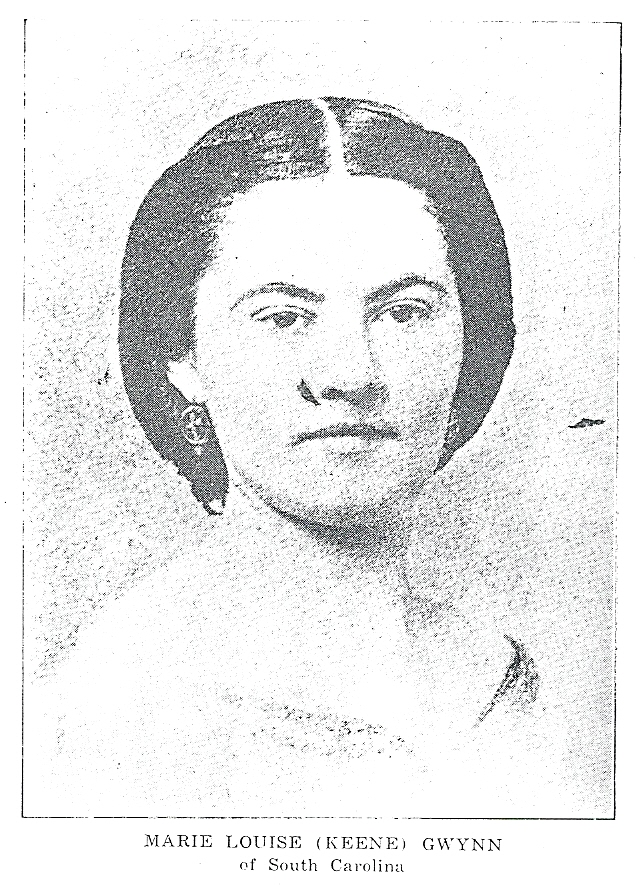
#52 Ancestors 2019 Week 17 At Worship: Marie Louise Keene Gwynn, Pioneer Catholic in Spartansburg SC


Marie Louise Keene, the daughter of Benjamin Gaither Keene and Susan Tubman McMullen and my 2X great-grandmother, was born at her father's home, Mount Pleasant, in Dorchester County on Maryland's Eastern Shore in 1841.  Her father was a convert to Catholicism and educated his daughters at Mount St. Joseph in Emmitsburg MD, where their mother had also attended. 

Marie Louise Keene was baptized at the Cathedral of the Assumption in Baltimore, where Col. Keene maintained a pew, on 23 March 1866. Her daughter, Effie Gwynn Bowie, reported that her mother's diary reveals that "for some years she had studied and prayed for the Kindly Light. " She married Captain Andrew Jackson Gwynn CSA at the Cathedral in 1869.


After the Civil War, Marie and AJ Gwynn settled in Spartanburg SC where they raised six children: Effie, Andrew, Louise (my great-grandmother), St. Charles, Mary, and John.  Always active in her community, Marie was instrumental in establishing the Kennedy Free Library, remaining an active member of the association until her death in 1912. 

But one of her main concerns was the lack of a Catholic Church in her city.  Catholicism was not strong in the south.  In 1820, 6 priests served the diocese of Charleston which covered the states of North and South Carolina and Georgia.  Spartanburg was part of a large mission territory served from Columbia SC. For more than a decade, Catholics gathered at the Gwynn home for Sunday worship. To facilitate the building of a church for Spartanburg, the Gwynns donated the land and then worked tirelessly to raise the money for building. The cornerstone for St. Paul's Church was laid on the 14th of October 1883 and it still serves the Spartanburg community.


Even after the church was built, the Gwynn's provided housing for the priests who would come to say Mass, until a permanent resident pastor was assigned in the early 1900's. 

Marie's strong devotion to Catholicism continued in her children. To the great pride of his mother, her oldest son, Andrew Keene Gwynn, entered the priesthood and was ordained in 1895 at the Cathedral in Charleston SC.  He served as the pastor of St. Mary's Church in Greenville SC from 1900 to 1951 and was designated a monsignor in 1930. Monsignor Gwynn officiated at all the family weddings and funerals, including the marriage of his nephew, my grandfather, Frank Phillip Scrivener. 
Marie's daughter, my great-grandmother, Louise Gwynn Scrivener, attended a Catholic college, Mount St. Agnes in Baltimore MD and was the founder and first governor of the Maryland chapter of the International Federation of Catholic Alumnae. She also helped to found the Pilgrims of St. Mary's, which celebrated Maryland's Catholic heritage. From these platforms, she crusaded tirelessly for Catholic education, among her many other civic causes. 


Wednesday, May 1, 2019

#52Ancestors 2019 Week 18: Road Trip Travelling the National Road from Calvert County MD to Belmont County OH

#52Ancestors 2019 Week 18: Road Trip Travelling the National Road from Calvert County MD to Belmont County OH

The National Road, authorized by Congress in 1806, was one of the first paved roads to cross the Appalachian Mountains.  Construction began in Cumberland MD and eventually the road extended to St. Louis MO.  Barnesville, Belmont County OH had quite a contingent of Calvert County families in the 1830's who followed the National  Road west.


Barnesville OH, which is near St. Clairsville on the map above, was founded by a Maryland Quaker, James Barnes, in 1806.  (Many Quakers migrated to OH in order to live in a free state rather than a slave state, and they were often active in the Underground Railroad.) 
By 1832, when Thomas Taneyhill and his wife Mary Scrivener (both distant cousins to me) emigrated to Barnesville with eight children, the town had 64 residences and about 400 inhabitants. (Thomas's son Richard Henry Taneyhill wrote a history of the town in 1899 which gives great detail of its growth and development.  See https://archive.org/stream/historyofbarnesv00tane/historyofbarnesv00tane_djvu.txt. )  Family tradition says that Mary Scrivener's father, William Scrivener, was a body guard of  George Washington during the Revolutionary War, but I have not been able to find evidence for this.

(Above: Cassellman River Bridge Constructed in 1813 as art of the National Road)
Thomas Taneyhill, the son of John Taneyhill and Lurana Smith, was a veteran of the War of 1812, having served in the 31st Regiment of the Maryland Militia under Captain Richard Ireland. He died in Barnesville in 1848.  His widow, Mary Scrivener Taneyhill, died in Barnesville in November 1866 at the home of her son-in-law, John Dove, also a native of Calvert County MD. Thomas and Mary's son William Scrivener Taneyhill, was the first lawyer in Barnesville.  
Several of Mary's nephews, the children of her sister Catherine Scrivener and Thomas Dew, also migrated to Barnesville from Calvert County: Thomas Henry Dew 1819-1897, Joseph Dew, and Jesse Dew 1822-1860. Elizabeth Dew married George Stamp in Calvert County and also moved to Barnesville with her three brothers and four daughters.

(Above: Mount Washington Tavern, Frederick MD, one of the busiest stage stops on the National Road in the early 19th century.)
James Scrivener, born in Calvert County in 1819 and probably the son of Francis and Ellen Scrivener, was a cousin of Mary and Catherine who also moved to Barnesville. He married in 1843 to Elizabeth Cox, the daughter of John Cox and Jane Eades, as her second husband.  Their son John Francis Scrivener, a shoemaker with a business in Barnesville, died there in 1884. 
Another Calvert Countian who shows up in Barnesville is Benjamin Hance Mackall (another distant cousin to me), born June 20, 1767 to John Mackall and Margaret Reynolds in Calvert County, MD. Mackall married Mary Wheeler Bond, daughter of Dr. John Bond and his wife Mary, on August 4, 1794 in Calvert County. The Mackall's had five children, including Harriet, Col. Benjamin Mackall, and John T. Mackall. 
Benjamin Hance Mackall was a member of the Maryland legislature and a deputy United States Marshal. Mackall owned land and enslaved people in Calvert County.  A few years after the War of 1812, Benjamin H. Mackall disposed of his property in Calvert County and moved his family to Warren, Ohio where they lived for eleven years. The family then settled in Barnesville, Ohio where Mackall was appointed post master. In 1824, Mackall mailed a claim  from Ohio to John Quincy Adams in Washington, DC in regards to the property that was carried off by the British. Mackall had a claim specifically for household items that were taken, and another claim that dealt with the loss of enslaved people. His claim for the household items was rejected by the commission who granted award money for claims under the Treaty of Ghent.

In 1828, Mackall purchased a drug store which housed medicine, paints, and oils. Mackall ran his store and continued to hold his position as post master in Belmont until his death. Benjamin Hance Mackall died May 16, 1835 in Barnesville, Ohio at the age of 65. Mackall's widow Mary died July 13, 1871 at the age of 93.

Their son, Benjamin Hance Mackall Jr., served as state senator in Ohio.